SURFING THE JET STREAM REDUCES AVIATION RADIATION: Last weekend, British Airways Flight 112 made headlines when it flew from New York to London in less than 5 hours, smashing the speed record for subsonic flight. It did it by surfing the jet stream. The plane's early arrival had an unintended benefit: Passengers absorbed significantly fewer cosmic rays. Surfing the jet stream, it turns out, is a good way to manage aviation radiation: full story.
THE CHANGING SHAPE OF BETELGEUSE: Betelgeuse isn't just dimming, it's also changing shape. Today, the European Southern Observatory released new images of Betelgeuse from the Very Large Telescope (VLT) in Chile's Atacama desert. The unstable red supergiant is definitely lopsided:
A team led by Miguel Montargès of KU Leuven in Belgium took the picture in Dec. 2019, shortly after the star began its unprecedented dimming. They were able to compare it to a "normal" picture of Betelgeuse taken 11 months earlier. The change in shape is striking.
What's going on? The researchers aren't sure why Betelgeuse looks so different, but they suspect the involvement of dust. Red supergiants like Betelgeuse create and eject vast amounts of dusty material, losing mass even before they explode as supernovas. The lopsided shape and dimming of Betelgeuse might be explained if a cloud of dust is partially blocking its disk. Indeed, VLT infrared observations of Betelgeuse at the same time reveal lots of dust around the star.
Mystery solved? Not necessarily. "Our knowledge of red supergiants remains incomplete, and this is still a work in progress, so a surprise can still happen," notes Montargès. Other possibilities include magnetic activity on Betelgeuse's surface (such as a giant starspot) and, of course, the early stages of a supernova explosion.
The Very Large Telescope with its adaptive optics instruments is one of the few facilities in the world capable of imaging the surface of Betelgeuse, located more thann 600 light years away. More images from the Atacama desert may yet reveal what's happening--if Betelgeuse doesn't tell us first!
Realtime Spaceweather Photo Gallery
Free: Spaceweather.com Newsletter
NEW IAU STATEMENT ON SATELLITE MEGA-CONSTELLATIONS: The night sky is in danger. This has been true for years as urban landscapes became increasingly light-polluted. But now there's a new threat, one you can't escape by driving into the countryside. It's the "mega-constellation." Some companies are planning to launch tens of thousands of internet satellites into low-Earth orbit. The recent launch by Space X of just 240 Starlink satellites has already ruined many astronomical observations.
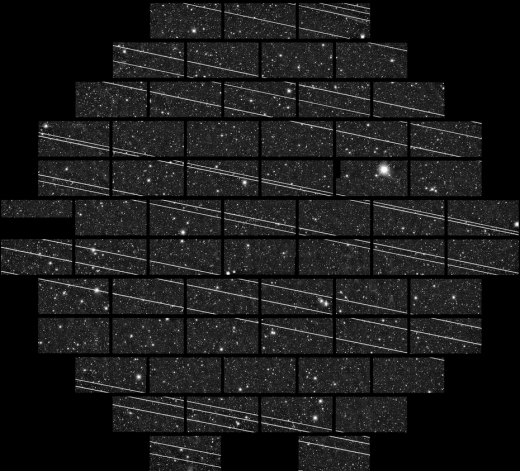
Above: Astronomers at the Cerro Tololo Inter-American Observatory were trying to photograph nearby galaxies when 19 Starlink satellites intervened. [Full Story]
This week the International Astronomical Union (IAU) issued a new press release describing the impact of satellite mega-constellations on astronomy. IAU astronomers simulated 25,000 satellites similar in type to the satellites of SpaceX, Amazon, and OneWeb, and here are their results:
1. The number of satellites above the horizon at any given time would be between ~1500 and a few thousand. Most will appear very close to the horizon, with only a relative few passing directly overhead.
2. When the sun is 18 degrees below the horizon--that is, when the night becomes dark--the number of illuminated satellites above the horizon would be around 1000. These numbers will decrease during the hours around midnight when many satellites fall into Earth's shadow.
3. At the moment it is difficult to predict how many of the illuminated satellites will be visible to the naked eye because of uncertainties in their reflectivity. Probably, the vast majority will be too faint to see. This depends to some degree on experiments such as those being carried out by SpaceX to reduce the reflectivity of their satellites with different coatings.
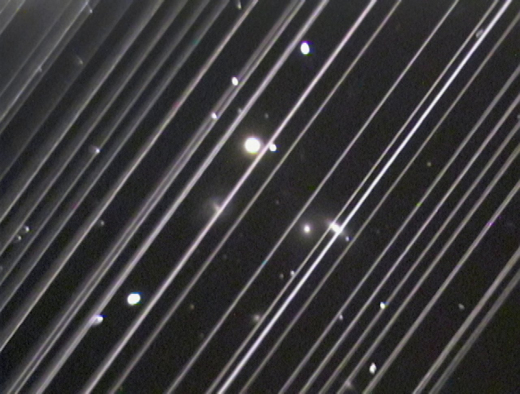
Above: Starlink satellites photobomb the NGC 5353/4 galaxy group at Lowell Observatory [more]4. Even if most satellites are invisible to the naked eye, mega-constellations pose a serious problem for professional astronomy. The trails of these satellites are bright enough to saturate modern detectors on large telescopes, and wide-field scientific astronomical observations will be severely affected.
5. The Vera C. Rubin Observatory currently under construction in Chile will be particularly hard-hit. The innovative observatory will scan large swaths of the sky, looking for near-Earth asteroids, studying dark energy, and much more. According to the IAU, up to 30% of the 30-second images during twilight hours will be affected. In theory, the effects of the new satellites could be mitigated by accurately predicting their orbits and interrupting observations, when necessary, during their passage, but this is a burdensome procedure.
There are no international rules governing the brightness of orbiting manmade objects. Until now, they didn't seem to be necessary. Mega-constellations, however, threaten "the uncontaminated view of the night sky from dark places, which should be considered a non-renounceable world human heritage," says the press release. Therefore the IAU will present its findings at meetings of the UN Committee for Peaceful Uses of Outer Space, bringing the attention of this problem to world leaders.
Realtime Spaceweather Photo Gallery
Free: Spaceweather.com Newsletter
VALENTINE'S GIFTS FROM THE EDGE OF SPACE: Today is Valentine's Day, and nothing says "I love you" like a gift from the edge of space. Everything in the Earth to Sky Store is 10% off:
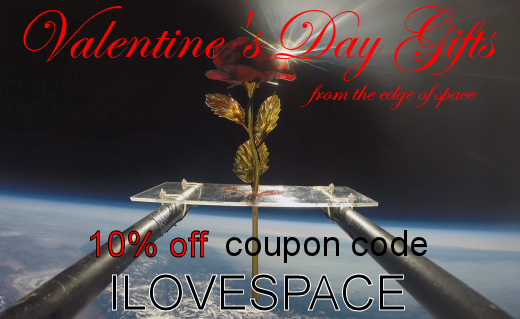
Everything in the store has been flown to the stratosphere onboard cosmic ray balloons, which the students of Earth to Sky Calculus launch approximately once a week to monitor atmospheric radiation. All sales support our cosmic ray ballooning program and help launch young scientists into research careers through hands-on STEM education.
At checkout, be sure to enter the coupon code "ILOVESPACE"!
Far Out Gifts: Earth to Sky Store
All sales support hands-on STEM education
Realtime Aurora Photo Gallery
Free: Spaceweather.com Newsletter