SURFING THE JET STREAM REDUCES AVIATION RADIATION: Last weekend, British Airways Flight 112 made headlines when it flew from New York to London in less than 5 hours, smashing the speed record for subsonic flight. It did it by surfing the jet stream. The plane's early arrival had an unintended benefit: Passengers absorbed significantly fewer cosmic rays. Surfing the jet stream, it turns out, is a good way to manage aviation radiation: full story.
THE CHANGING SHAPE OF BETELGEUSE: Betelgeuse isn't just dimming, it's also changing shape. Today, the European Southern Observatory released new images of Betelgeuse from the Very Large Telescope (VLT) in Chile's Atacama desert. The unstable red supergiant is definitely lopsided:
A team led by Miguel Montargès of KU Leuven in Belgium took the picture in Dec. 2019, shortly after the star began its unprecedented dimming. They were able to compare it to a "normal" picture of Betelgeuse taken 11 months earlier. The change in shape is striking.
What's going on? The researchers aren't sure why Betelgeuse looks so different, but they suspect the involvement of dust. Red supergiants like Betelgeuse create and eject vast amounts of dusty material, losing mass even before they explode as supernovas. The lopsided shape and dimming of Betelgeuse might be explained if a cloud of dust is partially blocking its disk. Indeed, VLT infrared observations of Betelgeuse at the same time reveal lots of dust around the star.:

Above: Clouds of dust around Betelgeuse. Credit: ESO/P. Kervella/M. Montargès et al. [more]
Mystery solved? Not necessarily. "Our knowledge of red supergiants remains incomplete, and this is still a work in progress, so a surprise can still happen," notes Montargès. Other possibilities include magnetic activity on Betelgeuse's surface (such as a giant starspot) and, of course, the early stages of a supernova explosion.
The Very Large Telescope with its adaptive optics instruments is one of the few facilities in the world capable of imaging the surface of Betelgeuse, located more thann 600 light years away. More images from the Atacama desert may yet reveal what's happening--if Betelgeuse doesn't tell us first!
Realtime Spaceweather Photo Gallery
Free: Spaceweather.com Newsletter
EARTH WAS NOT DESTROYED TODAY: For weeks, rumors have been swirling around the Internet about an asteroid that might hit Earth on Feb. 15th. It didn't. Earlier today, Alberto Quijano Vodniza and Esteban Botina photographed the space rock sailing harmlessly past our planet:

The asteroid, named "2002 PZ39," wasn't even close. The miss distance was 3.6 million miles--about 15 times farther away than the Moon.
There was never any danger. NASA has been tracking the 0.5 km asteroid for 17 years and long ago determined that a collision would not happen. Vodniza and Botina used NASA's ephemeris to catch the passing space rock with their 14-inch Celestron telescope in Pasto, Narino, Colombia.
Realtime Spaceweather Photo Gallery
Free: Spaceweather.com Newsletter
A GIFT FROM THE EDGE OF SPACE: Every time the students of Earth to Sky Calculus launch cosmic ray sensors to the stratosphere, they send a little something extra along for the ride. For example, this moonstone wrapped in a sterling silver Celtic love knot:
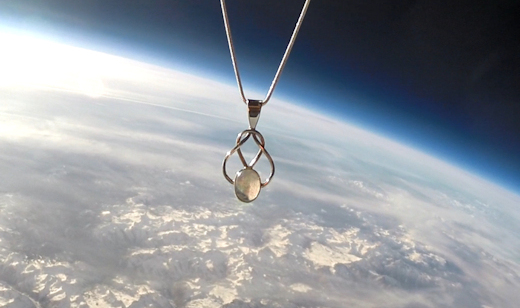
You can have it for $179.95. The students are selling these pendants as a fund-raiser for their cosmic ray monitoring program. They make great anniversary, birthday and Mother's Day gifts. Each pendant comes with a greeting card showing the jewelry in flight and telling the story of its journey to the stratosphere and back again.
Far Out Gifts: Earth to Sky Store
All sales support hands-on STEM education
Realtime Aurora Photo Gallery
Free: Spaceweather.com Newsletter