COSMIC RAYS ARE PEAKING: Once again, cosmic rays percolating through Earth's atmosphere are within a percentage point of the Space Age maximum. This is a symptom of Solar Minimum. When the sun's magnetic field weakens, it allows deep space radiation to enter the solar system. The current Solar Minimum is very deep, and consequently cosmic rays fluxes are very high. You can track the numbers right here on Spaceweather.com.

POLAR STRATOSPHERIC CLOUD ALERT: Arctic sky watchers should be alert for Type II polar stratospheric clouds (PSCs) this week--possibly on Feb 19th or 20th. PSCs form in the Arctic stratosphere when the temperature drops to a staggeringly low -85 C (188 K). NASA's MERRA-2 climate model suggests that such temperatures could occur in the days ahead. Note the yellow-circled forecast:

Widely regarded as the most beautiful clouds on Earth, PSCs are newsworthy because normally the stratosphere has no clouds at all. The stratosphere is arid and almost always transparent. Coaxing widely-spaced water molecules together to make icy stratospheric clouds requires extremely low temperatures. PSCs are far more rare than auroras.
The last time the temperature dropped so low, on Jan 22-23, 2020, a spectacular outbreak of PSCs blanketed northern Scandinavia. Jordan Herbst photographed the clouds from Abisko, Sweden:

"I couldn't believe my eyes when I looked out the window," says Herbst. "The clouds looked like auroras! I rushed outside, post-holing through deep snow to set up my camera with a good view of the PSCs over Mt. Nissuntjårro."
It could happen again this week if the forecast is correct. Arctic sky watchers, if you do see a PSC, submit your photos here.
Realtime Spaceweather Photo Gallery
Free: Spaceweather.com Newsletter
A GIFT FROM THE EDGE OF SPACE: Every time the students of Earth to Sky Calculus launch cosmic ray sensors to the stratosphere, they send a little something extra along for the ride. For example, this moonstone wrapped in a sterling silver Celtic love knot:
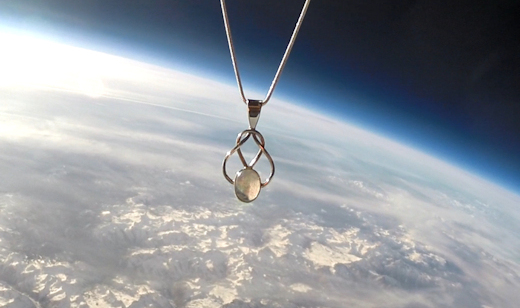
You can have it for $179.95. The students are selling these pendants as a fund-raiser for their cosmic ray monitoring program. They make great anniversary, birthday and Mother's Day gifts. Each pendant comes with a greeting card showing the jewelry in flight and telling the story of its journey to the stratosphere and back again.
Far Out Gifts: Earth to Sky Store
All sales support hands-on STEM education
Realtime Aurora Photo Gallery
Free: Spaceweather.com Newsletter