A MINOR STORM IS BREWING: A minor but long-lasting crack has opened in Earth's magnetic field. In the jargon of space weather forecasting, "BsubZ has been tilting south" for the past 8+ hours. Solar wind pouring through the gap is causing geomagnetic unrest, setting the state for polar auroras and possible G1-class geomagnetic storms on Feb. 18-19. Aurora alerts: SMS Text.


STARLINK BUZZES PUERTO RICO: SpaceX successfully launched another batch of 60 Starlink satellites on Feb. 17th. Just hours after the Falcon 9 rocket blasted off from Cape Canaveral, the newly released satellites flew over Puerto Rico where a meteor camera captured them flying single-file across the sky:
The camera is operated by the Astronomical Society of the Caribbean (Sociedad de Astronomia del Caribe), the largest astronomy group on the Island. "A couple of flashes are visible ahead of the main group of satellites, perhaps from parts or a pair of Starlink satellites ahead of the others," notes the Society.
This latest launch brings the total number of Starlink satellites in orbit to 300--a number that could grow to 42,000 by the time the Starlink project is complete. The good news is, Starlink could bring internet access to every corner of the world. The bad news is, Starlink poses a serious threat to astronomical research according to a recent study by the International Astronomical Union.
See for yourself. Starlink flyby predictions are available from Calsky and Heavens Above. (Got pictures? Submit them here.)
Realtime Spaceweather Photo Gallery
Free: Spaceweather.com Newsletter
AURORA SURPRISE: No sunspots. No solar flares. No gust of solar wind. In short, there was no reason to expect an outburst of auroras on Feb. 17th. Then this happened:

"Surprise auroras strike big!" exclaims Alexander Kuznetsov, who photographed the display from Kilpisjärvi, Finland. "At one point they went pink and moved very fast! I also saw a fast corona unfolding above me, reminding me of an angel."
"When I first went outside, I was not expecting much because the solar wind speed was relatively low, so I did not take my snowshoes," he says. "Then the show began. Currently, there is over a meter of snow in Kilpisjärvi, so I had to crawl through some snowy terrain to get to the best viewing spot."
Where did these auroras come from? A crack opened in Earth's magnetic field (that is, "BsubZ tilted south"). Solar wind poured in to fuel the display--no solar storm required.
Realtime Aurora Photo Gallery
Free: Spaceweather.com Newsletter
A GIFT FROM THE EDGE OF SPACE: Every time the students of Earth to Sky Calculus launch cosmic ray sensors to the stratosphere, they send a little something extra along for the ride. For example, this moonstone wrapped in a sterling silver Celtic love knot:
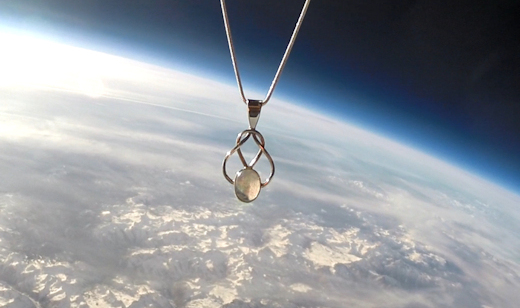
You can have it for $179.95. The students are selling these pendants as a fund-raiser for their cosmic ray monitoring program. They make great anniversary, birthday and Mother's Day gifts. Each pendant comes with a greeting card showing the jewelry in flight and telling the story of its journey to the stratosphere and back again.
Far Out Gifts: Earth to Sky Store
All sales support hands-on STEM education