SUBSIDING GEOMAGNETIC STORM: A G1-class geomagnetic storm that began during the early hours of Feb. 19th when Earth entered a high-speed solar wind stream is now subsiding. Arctic sky watchers should remain alert for occasional bright auroras as the event fitfully peters out. Aurora alerts: SMS Text.

MAGNETIC CRACK SPARKS RARE BLUE AURORAS: Yes, there really are cracks in Earth's magnetic field. One of them opened on Feb. 18th, sparking some of the strangest auroras in years. First, the night sky turned blue over the Lofoten Islands of Norway:

"After snow, sleet, and heavy wind all day, the clouds parted for a 2 hour display of spectacular pale green, blue, and purple auroras over the mountains of Reine," says photographer Matthew Steinberg.
Blue auroras are rare. Auroras are usually green, and sometimes red. Those are the colors produced by oxygen when it is excited by electrons raining down from space. Blue is a sign of nitrogen. Energetic particles striking ionized molecular nitrogen (N2+) at very high altitudes (> 400 km) produces a cold azure glow of the type captured in Steinberg's photo. Usually the blue is faint, but on Feb. 18th it was strangely intense.
Next, the auroras turned green again. But they were strangely shaped. This was the view from Tromsø, Norway:

"I couldn't believe my eyes," says photographer Markus Varik, a longtime aurora tour guide who previously thought he had seen it all. "This strange rippling band formation unfolded overhead. It was so different than the usual aurora arcs. Truly magic! Let's hope for some more strange shapes tomorrow!"
Indeed, it could happen. A G1-class geomagnetic storm is underway, and more Arctic auroras are in the offing. Stay tuned. Aurora alerts: SMS Text.
Realtime Aurora Photo Gallery
Free: Spaceweather.com Newsletter
A GIFT FROM THE EDGE OF SPACE: Every time the students of Earth to Sky Calculus launch cosmic ray sensors to the stratosphere, they send a little something extra along for the ride. For example, this Northern Lights pendant:
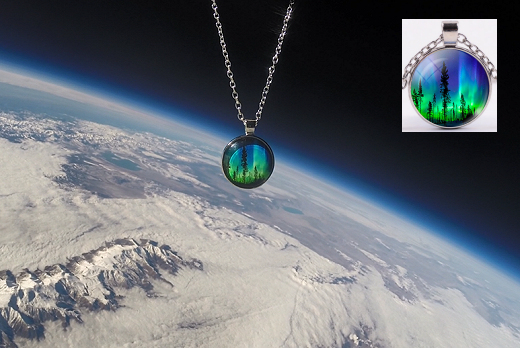
On Dec. 6, 2019, it flew 107,612 feet above the rugged Sierra Nevada mountains of central California.
You can have it for $129.95. The students are selling these pendants as a fund-raiser for their cosmic ray monitoring program. They make great anniversary, birthday and Mother's Day gifts. Each pendant comes with a greeting card showing the jewelry in flight and telling the story of its journey to the stratosphere and back again.
Far Out Gifts: Earth to Sky Store
All sales support hands-on STEM education
Realtime Spaceweather Photo Gallery
Free: Spaceweather.com Newsletter