SOLAR MINIMUM CONDITIONS ARE IN EFFECT: The sun has been blank (without sunspots) for 18 consecutive days. This is a sign that Solar Minimum is still underway despite recent signs of life from Solar Cycle 25. Even during the nadir of the solar cycle, however, it is still possible to observe bright polar auroras--as the events of Feb. 18-19 demonstrated. Aurora alerts: SMS Text.
BETELGEUSE IS BRIGHTENING AGAIN: "Don't panic! Betelgeuse is not likely to undergo a supernova explosion anytime soon," says South Korean research astronomer Bum-Suk Yeom. "The red supergiant star Betelgeuse appears to have finally stopped its unprecedented dimming. It's been brightening over the last few days." Yoem assembled this light curve from data collected by American Association of Variable Star Observers (AAVSO):

According to the data, Betelegeuse reached its minimum brightness between Feb. 12th and 14th, and now it is slowly brightening again.
This development was actually predicted. Ed Guinan and Richard Wasatonic of Villanova University recently suggested that Betelgeuse might "bounce back" within a week of Feb. 21st. Their prediction was based on a Fourier analysis of Betelgeuse's light curve, which revealed a strong 430-day period. If the current dimming were just an unusually deep dip in Betelgeuse's natural 430-day variability, they reasoned, its brightness should start to increase again on Feb 21st +/- 7 days.
Their prediction seems to be coming true. However, it is too early to draw a firm conclusion because the turnaround--if that is indeed what is happening---is still in its early stages. Stay tuned for updates.
Realtime Aurora Photo Gallery
Free: Spaceweather.com Newsletter
A GIFT FROM THE EDGE OF SPACE: Every time the students of Earth to Sky Calculus launch cosmic ray sensors to the stratosphere, they send a little something extra along for the ride. For example, this Northern Lights pendant:
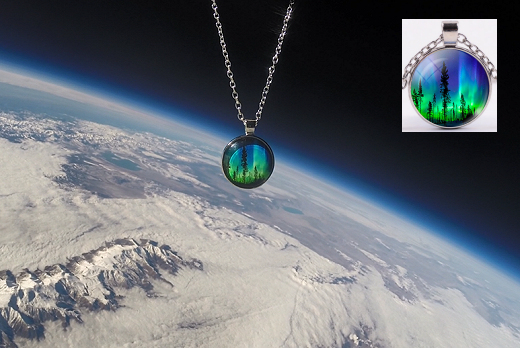
On Dec. 6, 2019, it flew 107,612 feet above the rugged Sierra Nevada mountains of central California.
You can have it for $129.95. The students are selling these pendants as a fund-raiser for their cosmic ray monitoring program. They make great anniversary, birthday and Mother's Day gifts. Each pendant comes with a greeting card showing the jewelry in flight and telling the story of its journey to the stratosphere and back again.
Far Out Gifts: Earth to Sky Store
All sales support hands-on STEM education
Realtime Spaceweather Photo Gallery
Free: Spaceweather.com Newsletter