SUPERNOVA WATCH, CANCELLED: Call off the supernova watch. Betelgeuse is brightening again. Researchers from Villanova University, who have been leading the study of Betelegeuse's unprecedented decline, have confirmed in a new Astronomical Telegram that the star has reversed itself. The turnaround was actually predicted, and suggests the recent dimming was an unusually deep excursion of the star's natural 430-day periodicity.
COMET ATLAS AND THE OWL NEBULA: Astronomers are keeping a close eye on Comet ATLAS (C/2019 Y4). Currently beyond the orbit of Mars, the dirty snowball from deep space is falling toward the sun--and it has recently tripled in brightness, possibly signalling an explosion of dust and gas in the comet's core. In late May, it will swoop inside the orbit of Mercury and could become very bright, indeed.
First, though, Comet ATLAS has a date with the Owl Nebula. Michael Jäger of Weißenkirchen, Austria, photographed the comet approaching the Owl on Feb. 21st:

"On Feb. 24-25, the nebula and the comet will be about 1 degree apart," notes Jäger. Can you say, "photo-op?"
The Owl Nebula is an expanding shell of gas ejected from an old red giant star about 2,030 light years from Earth. Astronomers call such shells "planetary nebulae" because their spherical forms look like planets. In fact, they are signposts of dying stars.
Comet ATLAS may be the signpost of ... a dying comet. Its orbit is strikingly similar to that of the Great Comet of 1844, which was visible in broad daylight when it passed very close to the sun in the 19th century. Comet ATLAS may be a fragment of that Great Comet--or perhaps a sibling comet, spawned by an even greater parent disintegrating 1000+ years ago.

Above: Click to view an interactive 3D orbit of Comet ATLAS from JPL.
At the moment, Comet ATLAS is slowly gliding through the Big Dipper (Ursa Major) shining like a 12th magnitude star. It is invisible to the unaided eye but an easy target for experienced astrophotographers with mid-sized backyard telescopes. When the comet plunges toward the sun in late May it will probably be overwhelmed by glaring sunlight and, thus, invisible. On the other hand, it is a relative of the Great Comet of 1844, so who knows? Stay tuned.
Realtime Aurora Photo Gallery
Free: Spaceweather.com Newsletter
A GIFT FROM THE EDGE OF SPACE: Every time the students of Earth to Sky Calculus launch cosmic ray sensors to the stratosphere, they send a little something extra along for the ride. For example, this Northern Lights pendant:
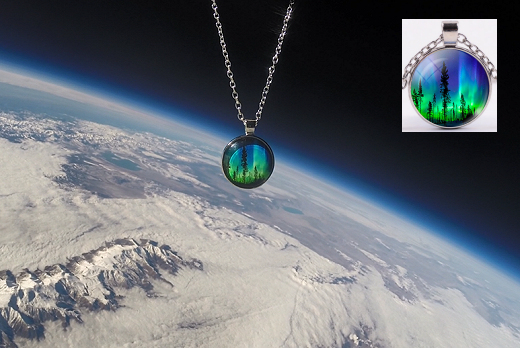
On Dec. 6, 2019, it flew 107,612 feet above the rugged Sierra Nevada mountains of central California.
You can have it for $129.95. The students are selling these pendants as a fund-raiser for their cosmic ray monitoring program. They make great anniversary, birthday and Mother's Day gifts. Each pendant comes with a greeting card showing the jewelry in flight and telling the story of its journey to the stratosphere and back again.
Far Out Gifts: Earth to Sky Store
All sales support hands-on STEM education
Realtime Spaceweather Photo Gallery
Free: Spaceweather.com Newsletter