SUPERNOVA WATCH, CANCELLED: Call off the supernova watch. Betelgeuse is brightening again. Researchers from Villanova University, who have been leading the study of Betelegeuse's unprecedented decline, have confirmed in a new Astronomical Telegram that the star has reversed itself. The turnaround was actually predicted, and suggests the recent dimming was an unusually deep excursion of the star's natural 430-day periodicity.
Here are the latest data from the American Association of Variable Star Observers (AAVSO):

According to the light curve, Betelgeuse hit bottom during the week of Feb. 7th - 13th with a V magnitude slightly greater than +1.6. "Based on these and additional observations, Betelgeuse has definitely stopped dimming and has started to slowly brighten," says Ed Guinan of Villanova University. "Thus, this 'fainting' episode is over."
The monitoring should continue, however. Sensational images captured last month by the ESO's Very Large Telescope in Chile revealed that one half of Betelgeuse was dimming more than the other. No one knows why. Additional imaging during Betelgeuse's recovery might unravel the mystery.
Realtime Spaceweather Photo Gallery
Free: Spaceweather.com Newsletter
STARLINK'S DARKSAT IS NOT SO DARK: Last November, SpaceX tried to save astronomy. Among 60 bright and shiny Starlink satellites that blasted off from Cape Canaveral on Nov. 11, 2020, was one "Darksat"--a Starlink satellite with an experimental anti-reflective coating. Making Starlink satellites darker could head off a brewing confrontation between astronomers and internet entrepreneurs.
"But is 'Darksat' really darker?" asks astrophotographer Thierry Legault. "On Saturday morning at astronomical twilight, I filmed the passage of a group of Starlink satellites at their final altitude (550 km). Darksat is one of the brightest."

"On the images covering more than 80° on the sky (from Lyra to Bootes), these satellites reached magnitude 2.5, which is even brighter than I expected! We are still waiting for effective albedo reduction measures, and in the meantime the launches continue..." he says.
Indeed, SpaceX has conducted three more launches since last November, bringing the total number of Starlink satellites in orbit to 300. Ultimately, the network of internet satellites could grow as large as 42,000. That's a lot of artificial stars--and so far the Darksat experiment has not succeeded in reducing their visibility. Keep trying, SpaceX.
Realtime Spaceweather Photo Gallery
Free: Spaceweather.com Newsletter
A GIFT FROM THE EDGE OF SPACE: Every time the students of Earth to Sky Calculus launch cosmic ray sensors to the stratosphere, they send a little something extra along for the ride. For example, this Northern Lights pendant:
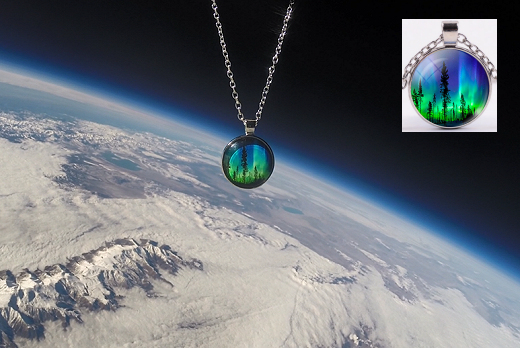
On Dec. 6, 2019, it flew 107,612 feet above the rugged Sierra Nevada mountains of central California.
You can have it for $129.95. The students are selling these pendants as a fund-raiser for their cosmic ray monitoring program. They make great anniversary, birthday and Mother's Day gifts. Each pendant comes with a greeting card showing the jewelry in flight and telling the story of its journey to the stratosphere and back again.
Far Out Gifts: Earth to Sky Store
All sales support hands-on STEM education
Realtime Aurora Photo Gallery
Free: Spaceweather.com Newsletter