BETELGEUSE IS BRIGHTENING AGAIN: Call off the supernova watch. Betelgeuse is brightening again. Researchers from Villanova University, who have been leading the study of Betelegeuse's unprecedented decline, have confirmed in a new Astronomical Telegram that the star has reversed itself. The turnaround was actually predicted, and suggests the recent dimming was an unusually deep excursion of the star's natural 430-day periodicity. FULL STORY.
COMET ATLAS BUZZES THE OWL NEBULA: Comet ATLAS (C/2019 Y4) is plunging toward the sun for a scorching close encounter at the end of May. First, though, the comet paid a visit to the Owl Nebula (M97). Michael Jäger of Weißenkirchen, Austria, photographed the flyby last night:

The Owl Nebula is the spherical object near the bottom of the image. It is the gaseous shell of an old red giant star more than 2000 light years from Earth. Also shown is the Surfboard Galaxy (M108) in the upper right.
On May 31, 2020, Comet ATLAS will dip inside the orbit of Mercury only 0.25 AU from the sun. ATLAS's orbit is strikingly similar to that of the Great Comet of 1844, which was visible in broad daylight when it passed very close to the sun in the 19th century. Indeed, Comet ATLAS may be a fragment of that Great Comet. Will it too become visible in broad daylight? Or will it evaporate before it gets a chance to really shine? No one knows. Whatever happens, the Heliospheric Imager onboard NASA's STEREO-A spacecraft will be able to record the action. Stay tuned.
Realtime Comet Photo Gallery
Free: Spaceweather.com Newsletter
SQUISH, SQUISH, AURORA BOREALIS: Can auroras make your feet wet? They did Sunday night. Danish photographer Ruslan Merzlyakov almost turned around to drive home on Feb. 23rd when he saw the flooded path to the Uggerby river. "Due to a record amount of rainfall this month, everything was completely flooded," Merzlyakov says. "There was absolutely no sign of the walking path, as it turned into a huge sea stretching towards the beach." But then he noticed a colorful glow on the horizon:

"I decided to photograph the sky despite the wet conditions--and I'm so glad I did," he says. "A 30 second exposure revealed the Milky Way, a dancing band of auroras, and some crazy red airglow as well."
The flooded path turned out to be photogenic, capturing a reflection of the sky overhead. Indeed, it was a good night, after all. The Moon was New, allowing Merzlyakov to see the faint rippling airglow, and a small crack opened in Earth's magnetic field, permitting solar wind to enter and fuel the auroras. Next time, though, Merzlyakov is bringing galoshes.
Realtime Aurora Photo Gallery
Free: Spaceweather.com Newsletter
STARLINK'S DARKSAT IS NOT SO DARK: Last November, SpaceX tried to save astronomy. Among 60 bright and shiny Starlink satellites that blasted off from Cape Canaveral on Nov. 11, 2019, was one "Darksat"--a Starlink satellite with an experimental anti-reflective coating. Making Starlink satellites darker could head off a brewing confrontation between astronomers and internet entrepreneurs.
"But is 'Darksat' really darker?" asks astrophotographer Thierry Legault. "On Saturday morning at astronomical twilight, I filmed the passage of a group of Starlink satellites at their final altitude (550 km). Darksat is one of the brightest."

"On the images covering more than 80° on the sky (from Lyra to Bootes), these satellites reached magnitude 2.5, which is even brighter than I expected! We are still waiting for effective albedo reduction measures, and in the meantime the launches continue..." he says.
Indeed, SpaceX has conducted three more launches since last November, bringing the total number of Starlink satellites in orbit to 300. Ultimately, the network of internet satellites could grow as large as 42,000. That's a lot of artificial stars--and so far the Darksat experiment has not succeeded in reducing their visibility. Keep trying, SpaceX.
Realtime Spaceweather Photo Gallery
Free: Spaceweather.com Newsletter
A GIFT FROM THE EDGE OF SPACE: Every time the students of Earth to Sky Calculus launch cosmic ray sensors to the stratosphere, they send a little something extra along for the ride. For example, this Northern Lights pendant:
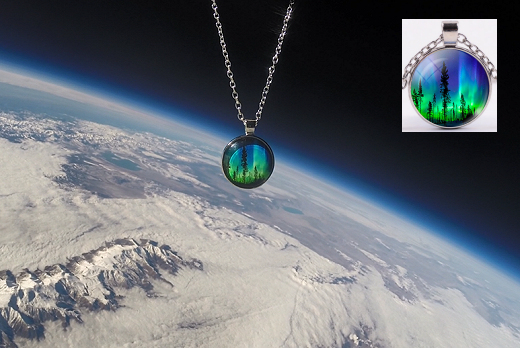
On Dec. 6, 2019, it flew 107,612 feet above the rugged Sierra Nevada mountains of central California.
You can have it for $129.95. The students are selling these pendants as a fund-raiser for their cosmic ray monitoring program. They make great anniversary, birthday and Mother's Day gifts. Each pendant comes with a greeting card showing the jewelry in flight and telling the story of its journey to the stratosphere and back again.
Far Out Gifts: Earth to Sky Store
All sales support hands-on STEM education