SUNSET SKY SHOW: When the sun goes down tonight, step outside and look west. The crescent Moon is approaching Venus for a side-by-side meeting on Feb. 27th. Be sure to look for a ghostly image of the full Moon inside the arms of the crescent. That's the Da Vinci Glow. Pictures are easy to take and may be submitted here.
WHAT'S HAPPENING ON THE FAR SIDE OF THE SUN? The sun has been blank for 25 consecutive days--no sunspots for almost a month. Maybe that's about to change. NASA's STEREO-A spacecraft is monitoring the sun's farside, and it has detected a pair of active regions hiding there. They are circled in this extreme ultraviolet image taken on Feb. 27th:

These might be sunspots. If so, the glow is due to hot gas trapped in the sunspots' magnetic canopies, something that STEREO-A's extreme UV telescope is very good at detecting. The high latitude of one region links it to Solar Cycle 25 (SC25), so this may be another sign of life from the next solar cycle.
Solar observers should keep an eye on the sun's eastern limb in the days ahead. Sunspots might be in the offing.
Realtime Aurora Photo Gallery
Free: Spaceweather.com Newsletter
TWO HEMISPHERES, ONE SKY: Earth. You can't live without it. On the other hand, it does block half of the night sky. Astronomers Petr Horálek and Juan Carlos Casado decided to solve this problem. "We did it by photographing the sky from opposite hemispheres," explains Horálek. "Both views, stitched together as one, finally reveal the entire night sky."

To create this unique image, Horálek stationed himself at the La Silla Observatory in Chile. Juan Carlos Casado set up his camera at the La Palma Observatory in the Canary Islands. The two observatories have almost exactly the same latitude--albeit with signs reversed. If you could look up from both places, simultaneously, you would see the picture above.
"We decided to take our pictures on nights when the column of zodiacal light (the dusty backbone of the solar system) jutted up almost perpendicular to the local horizon," says Horálek. "For me that happened in April 2016. We had to wait almost 4 years for the second half of our picture. Juan Carlos Casado captured his shot just this month, February 2020."
It was worth the wait! The full story of this image may be found on Horálek's photography blog.
Realtime Space Weather Photo Gallery
Free: Spaceweather.com Newsletter
A GIFT FROM THE EDGE OF SPACE: Every time the students of Earth to Sky Calculus launch cosmic ray sensors to the stratosphere, they send a little something extra along for the ride. For example, this Northern Lights pendant:
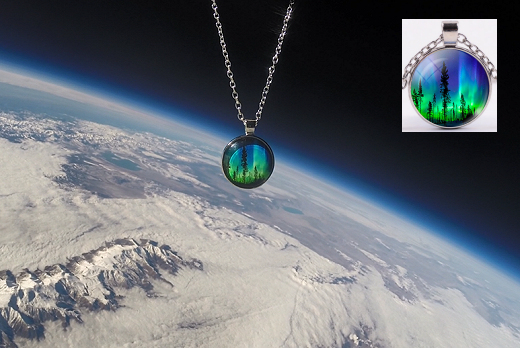
On Dec. 6, 2019, it flew 107,612 feet above the rugged Sierra Nevada mountains of central California.
You can have it for $129.95. The students are selling these pendants as a fund-raiser for their cosmic ray monitoring program. They make great anniversary, birthday and Mother's Day gifts. Each pendant comes with a greeting card showing the jewelry in flight and telling the story of its journey to the stratosphere and back again.
Far Out Gifts: Earth to Sky Store
All sales support hands-on STEM education