THE SURPRISING WAY SOLAR STORMS BEACH WHALES: A new study published this week in the research journal Current Biology shows that solar storms can confuse grey whales and cause them to strand on beaches. Surprisingly, the problem is *not* caused by geomagnetic storms. Instead, solar radio bursts are throwing the whales off course. FULL STORY.
DAYLIGHT FIREBALL OVER CROATIA: On Feb. 28th, residents of Croatia where shocked--literally--when a space rock exploded over Zagreb. Windows rattled, the ground shook, and a loud noise rumbled across the landscape as the fireball flashed brightly enough to see in broad daylight. Tomislav Čar captured this dashcam video at 10:34 AM local time:
"I personally heard it. An ear-witness, if you will," reports Iva Tatić of Total Croatia News. I was sitting in my chair [when] I heard a loud, deep rumbling, unlike the usual sounds happening in my neighborhood around this time of day. My first thought was that there was a very large truck in the very narrow street beneath my window, but there was no truck. Then I concluded it must've been an earthquake."
Indeed, Tatić says, "many people shared how they also *felt* the earthquake, in addition to hearing the loud sound." Minutes later the European-Mediterranean Seismological Centre announced that their seismometers had detected a minor earthquake in the area.
The shaking of the ground was not caused by the space rock hitting Earth. Instead, atmospheric shock waves from the explosion were responsible. Local astronomers are reportedly searching the area to see if fragments survived the descent and may be recovered as meteorites.

Above: In this CNEOS map of meteor strikes, the Croatian fireball is denoted by red arrows. [more]
According to JPL's Center for Near-Earth Object Studies (CNEOS), the energy of the explosion was approximately equal to 340 tons of TNT. Such meteors are detected somewhere on Earth ~10 times each year.
Realtime Aurora Photo Gallery
Free: Spaceweather.com Newsletter
A BLACK PEARL IN THE STRATOSPHERE: It came from Tahiti--and now it's been to the edge of space. On Feb. 27, 2020, this genuine Black Tahitian South Sea Cultured Pearl flew to the stratosphere onboard an Earth to Sky Calculus cosmic ray balloon, soaring more than 100,000 feet above the Sierra Nevada mountains of central California:
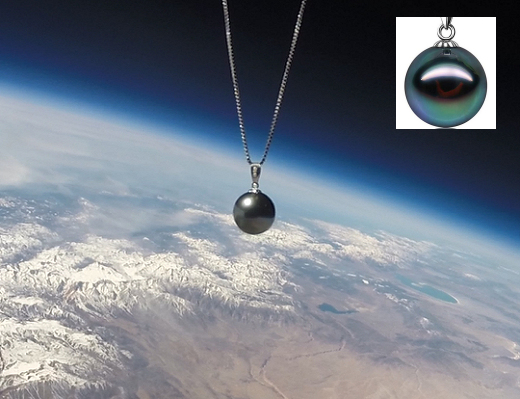
You can have it for $209.95. The students are selling these exotic space pearls to fund their cosmic ray monitoring program. Measuring 10 mm in diameter, the pearl has an 18K white gold clasp and is suspended from a matching 925 Sterling Silver chain. Each pearl comes with a greeting card showing the pendant in flight and telling the story of its journey to the edge of space.
Far Out Gifts: Earth to Sky Store
All sales support hands-on STEM education
Realtime Space Weather Photo Gallery
Free: Spaceweather.com Newsletter