MARCH IS THE BEST MONTH OF THE YEAR FOR AURORAS: Did you know that March is the best month of the year for auroras? It's true. A 75-year study shows that March has more geomagnetically active days than any other month of the year. (October is a close second.) This is due to the Russell-McPherron effect. In short, cracks tend to form in Earth's magnetosphere during weeks around equinoxes, allowing solar wind to spark Northern Lights. Aurora alerts: SMS Text.

FLOATING LIGHT PILLARS: Not everything that looks like an aurora actually is an aurora. For example, on Feb. 29th, Terrence Cook saw these colorful columns of flight floating above La Sal, Utah:

The lights resembled auroras, but they had nothing to do with space weather. "These are light pillars," explains Cook. "Ice crystals falling down from a mid-level cloud deck caught the glow of urban lights from Monticello, Utah, about 30 miles away." Crystal faces spread the glow into colorful columns. The dominant red-orange hue of the brightest columns is probably due to high pressure sodium lamps. Modern LED lamps create blue-white pillars.
At this time of year, light pillars are a common sight at northern latitudes. Normally they spring up from the ground where urban lights are located. These 'floating' pillars are more unusual. Unseasonably warm temperatures near the ground may have melted the crystals there, effectively deleting the bottom of these pillars. A bank of low clouds might have also blocked the bottoms from view.
Realtime Aurora Photo Gallery
Free: Spaceweather.com Newsletter
A BLACK PEARL IN THE STRATOSPHERE: It came from Tahiti--and now it's been to the edge of space. On Feb. 27, 2020, this genuine Black Tahitian South Sea Cultured Pearl flew to the stratosphere onboard an Earth to Sky Calculus cosmic ray balloon, soaring more than 100,000 feet above the Sierra Nevada mountains of central California:
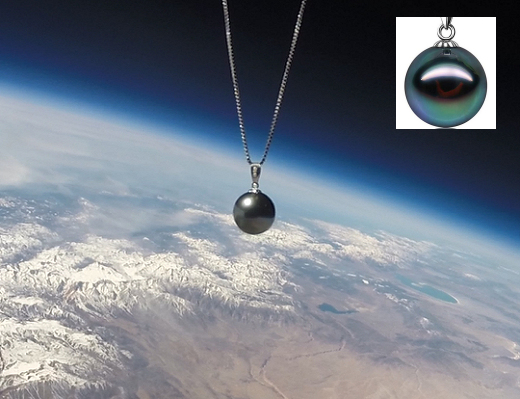
You can have it for $209.95. The students are selling these exotic space pearls to fund their cosmic ray monitoring program. Measuring 10 mm in diameter, the pearl has an 18K white gold clasp and is suspended from a matching 925 Sterling Silver chain. Each pearl comes with a greeting card showing the pendant in flight and telling the story of its journey to the edge of space.
Far Out Gifts: Earth to Sky Store
All sales support hands-on STEM education
Realtime Space Weather Photo Gallery
Free: Spaceweather.com Newsletter