MARCH IS THE BEST MONTH OF THE YEAR FOR AURORAS: Did you know that March is the best month of the year for auroras? It's true. A 75-year study shows that March has more geomagnetically active days than any other month of the year. (October is a close second.) This is due to the Russell-McPherron effect. In short, cracks tend to form in Earth's magnetosphere during weeks around equinoxes, allowing solar wind to spark Northern Lights. Aurora alerts: SMS Text.

THE WARMING EFFECT OF ARCTIC AURORAS: A minor stream of solar wind is buffeting Earth's magnetic field and this is causing geomagnetic unrest around the Arctic Circle. Last night in Helligskogen, Norway, the wind's effect was obvious in the midnight sky:

"What an amazing display," says Marianne Bergli, who took the picture. Marianne is an aurora tour guide. Her guests were sitting around the fire eating toasted sausages and drinking hot chocolate when the lights appeared. "Although the air temperature was -27 C, everyone was excited to leave the fire and rush out to see the auroras. There's more than one way to stay warm here in the Arctic :)"
More Arctic auroras are possible tonight. The solar wind is not causing a full-fledged geomagnetic storm, but its action is just enough for midnight lights. Aurora alerts: SMS Text.
Realtime Aurora Photo Gallery
Free: Spaceweather.com Newsletter
WITHOUT SUNSPOTS, THE SUN IS COVERED WITH.... The sun has been blank for 30 consecutive days--a sign that Solar Minimum is underway. Yesterday, amateur astronomer Martin Wise of Trenton, Florida, took a close look at the sun's surface. He couldn't find a single dark core. Instead, there were thousands of granules:

"The sun was covered with them," he says.
The sun is so hot, it literally boils. Bumps on the boiling surface of the sun are called "granules." You can find granules in your kitchen, too, in a pot of hot water boiling on the stove. One difference: While the granules on your stove are only a few centimeters across, granules on the sun are as wide as Texas.

Got it? Now you're ready for the Solar Granulation Quiz.
Realtime Space Weather Photo Gallery
Free: Spaceweather.com Newsletter
A BLACK PEARL IN THE STRATOSPHERE: It came from Tahiti--and now it's been to the edge of space. On Feb. 27, 2020, this genuine Black Tahitian South Sea Cultured Pearl flew to the stratosphere onboard an Earth to Sky Calculus cosmic ray balloon, soaring more than 100,000 feet above the Sierra Nevada mountains of central California:
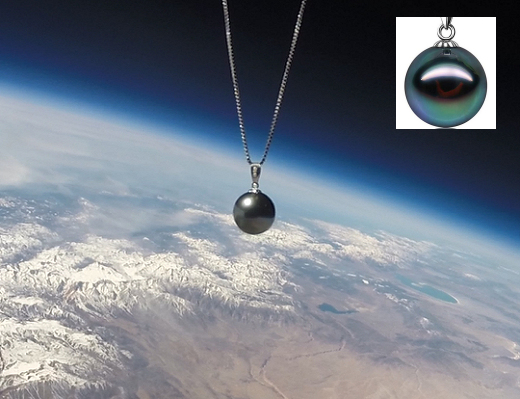
You can have it for $209.95. The students are selling these exotic space pearls to fund their cosmic ray monitoring program. Measuring 10 mm in diameter, the pearl has an 18K white gold clasp and is suspended from a matching 925 Sterling Silver chain. Each pearl comes with a greeting card showing the pendant in flight and telling the story of its journey to the edge of space.
Far Out Gifts: Earth to Sky Store
All sales support hands-on STEM education