MARCH IS THE BEST MONTH OF THE YEAR FOR AURORAS: Did you know that March is the best month of the year for auroras? It's true. A 75-year study shows that March has more geomagnetically active days than any other month of the year. (October is a close second.) This is due to the Russell-McPherron effect. In short, cracks tend to form in Earth's magnetosphere during weeks around equinoxes, allowing solar wind to spark Northern Lights. Aurora alerts: SMS Text.

COMET ATLAS IS PLUNGING TOWARD THE SUN: Comet ATLAS (C/2019 Y4) is coming ... and the sun is waiting. In late May, the dirty snowball will dip inside the orbit of Mercury, passing only 0.25 AU from the sun. No one knows what will happen when the comet's icy core is exposed to solar heat at point blank range.

Above: Comet ATLAS photographed on Feb. 29, 2020, by Hisayoshi Kato of Makioka, Japan
"ATLAS is a bit of a wildcard, and there's a spectrum of possibilities as it nears the sun," says Karl Battams of the Naval Research Lab in Washington DC. "At one extreme, it could simply crumble away in the coming weeks, and at the other extreme it could brighten up tremendously. It has an unusually small perihelion distance inside of Mercury's orbit, which bodes well for getting those frozen gases fizzing furiously."
At the moment Comet ATLAS is beyond the orbit of Mars. Even at that great distance, it is already brightening, shooting up 100-fold since the beginning of February. Currently, it looks like a fuzzy star of 11th magnitude in the Big Dipper--an easy target for backyard telescopes.
By the end of May, the comet could be as bright as a 1st magnitude star. Astronomers will be struggling to see it, however, through the glare of the approaching sun.
"All is not lost!" says Battams. "We have a number of space telescopes designed to view objects very close to the sun. For instance, the Heliospheric Imager on NASA's STEREO spacecraft will get a great view of ATLAS from mid-May through early June. The camera is very sensitive, so we might be able to observe ATLAS's tail interacting with the solar wind and outflows."
Above: STEREO's Heliospheric Imager recorded Comet PanSTARRS in 2013.
"There's also the WISPR camera on NASA's Parker Solar Probe," he continues. "We will potentially be able view ATLAS from WISPR, concurrently with the STEREO observations, but it would require a non-standard pointing configuration for us, so the operation teams are currently assessing our options."
Can't wait for May? Amateur astronomers with mid-sized backyard telescopes can observe Comet ATLAS now. Monitoring is encouraged. Outbursts are possible in the weeks ahead as new veins of volatile material are exposed by intensifying sunlight. Point your optics using this ephemeris from JPL and submit your images here.
Realtime Space Weather Photo Gallery
Free: Spaceweather.com Newsletter
A BLACK PEARL IN THE STRATOSPHERE: It came from Tahiti--and now it's been to the edge of space. On Feb. 27, 2020, this genuine Black Tahitian South Sea Cultured Pearl flew to the stratosphere onboard an Earth to Sky Calculus cosmic ray balloon, soaring more than 100,000 feet above the Sierra Nevada mountains of central California:
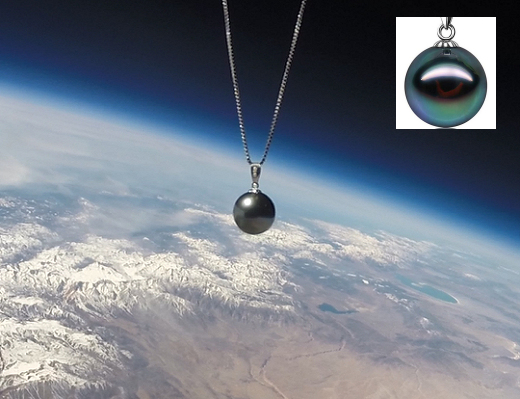
You can have it for $209.95. The students are selling these exotic space pearls to fund their cosmic ray monitoring program. Measuring 10 mm in diameter, the pearl has an 18K white gold clasp and is suspended from a matching 925 Sterling Silver chain. Each pearl comes with a greeting card showing the pendant in flight and telling the story of its journey to the edge of space.
Far Out Gifts: Earth to Sky Store
All sales support hands-on STEM education
Realtime Aurora Photo Gallery
Free: Spaceweather.com Newsletter