POSSIBLE CME IMPACT ON MARCH 7th: Earlier this week (March 2nd) NASA's STEREO spacecraft saw a faint coronal mass ejection (CME) billowing away from the sun. The slow-moving cloud could hit Earth's magnetic field on March 7th, bringing enhanced magnetic fields capable of sparking Arctic auroras. This is a very uncertain forecast; no guarantees! Aurora alerts: SMS Text.
STARLINK PHOTOBOMBS VENUS AND URANUS: Venus and Uranus are converging in the constellation Aries for a loose conjunction on March 9th. Monitoring their approach, David Blanchard of Flagstaff, Arizona, tried to photograph the two planets on March 4th. "I was photo-bombed by Starlink!" he reports.

During Blanchard's exposure (15s with 3s gaps), a half dozen of SpaceX's internet satellites streaked between the planets. "At least one Starlink flared and was briefly one of the brightest star-like objects in the sky -- only exceeded by the Moon, Venus, and perhaps Sirius," he says.
It could have been worse. SpaceX has recently launched 300 Starlink satellites--a number which could grow as large as 42,000 in the years ahead. When the mega-constellation is complete, more than 1500 satellites could be above the horizon at any moment, according to an analysis by the International Astronomical Union. Meanwhile, efforts by SpaceX to darken their satellites have been unsuccessful.
Realtime Space Weather Photo Gallery
Free: Spaceweather.com Newsletter
A STANDING WAVE CLOUD AT SUNRISE: Wednesday morning when the sun came up over Mutare, Zimbabwe, Peter Lowenstein saw a cloud shaped like a hill. No coincidence. It was shaped by a hill. "During my early morning walk, I was surprised by the appearance of this unusual low-level standing wave cloud above a familiar saddle on a hill in Cecil Kop Nature Reserve," says Lowenstein, who animated his hurriedly-taken photos:

Standing wave clouds appear when air is forced to flow over a mountain or tall hill. Cool air at the crest of the wave often forms a lens-shaped structure that resembles a spaceship--a.k.a. a "lenticular cloud." Such clouds normally hover above the terrain that shapes them. In this case, something different happened.
"A strong updraft carried the standing wave cloud away," says Lowenstein. "After that, it was only visible for about two minutes before dissipating."
Realtime Space Weather Photo Gallery
Free: Spaceweather.com Newsletter
A BLACK PEARL IN THE STRATOSPHERE: It came from Tahiti--and now it's been to the edge of space. On Feb. 27, 2020, this genuine Black Tahitian South Sea Cultured Pearl flew to the stratosphere onboard an Earth to Sky Calculus cosmic ray balloon, soaring more than 100,000 feet above the Sierra Nevada mountains of central California:
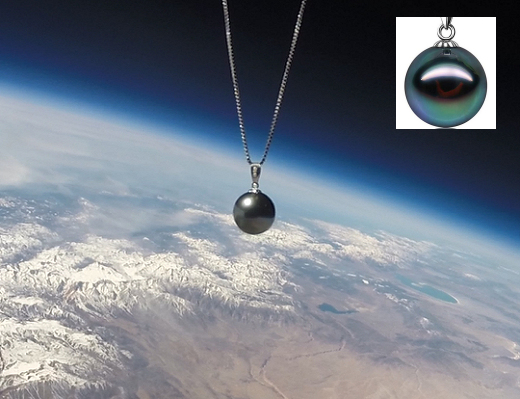
You can have it for $219.95. The students are selling these exotic space pearls to fund their cosmic ray monitoring program. Measuring 10 mm in diameter, the pearl has an 18K white gold clasp and is suspended from a matching 925 Sterling Silver chain. Each pearl comes with a greeting card showing the pendant in flight and telling the story of its journey to the edge of space.
Far Out Gifts: Earth to Sky Store
All sales support hands-on STEM education
Realtime Aurora Photo Gallery
Free: Spaceweather.com Newsletter