A NEW SUNSPOT: Breaking a string of 34 spotless days, a new sunspot is emerging in the sun's southern hemisphere, right here. The high latitude and magnetic polarity of the sunspot identify it as a likely member of new Solar Cycle 25. Aurora alerts: SMS Text.

GET READY FOR SPRITE SEASON: Sprite season is coming. Spring thunderstorms often produce the year's first big bursts of upward-directed lightning--a.k.a. "sprites". To get ready, Puerto Rican sprite chaser Frankie Lucena has prepared a chart to identify the different forms, including a newly-discovered type of sprite called "the Ghost."

More information and image credits may be found here.
"This chart provides just a glimpse of what can be seen and photographed above very strong thunderstorms," says Lucena. "I used actual images, enhanced and slightly modified to better show what they actually look like."
"This is the first chart to show the Ghost and a Negative Sprite event," he continues. "The Ghost is a green colored shadow that appears above some sprites. The green color is caused by electrons exciting oxygen molecules in the mesosphere, approximately 80 km high. A Negative Sprite is triggered by a -CG lightning discharge as opposed to a regular sprite which is triggered by a +CG lightning discharge." (Note: CG means "cloud to ground.")

Back in the 1980s when sprites were accidentally photographed by researchers from the University of Minnesota, only one form was known: The basic sprite. Since then observers have discovered an entire menagerie. Ghosts are the latest, but probably not the last. Stay tuned for the latest as sprite season begins.
Realtime Space Weather Photo Gallery
Free: Spaceweather.com Newsletter
A BLACK PEARL IN THE STRATOSPHERE: It came from Tahiti--and now it's been to the edge of space. On Feb. 27, 2020, this genuine Black Tahitian South Sea Cultured Pearl flew to the stratosphere onboard an Earth to Sky Calculus cosmic ray balloon, soaring more than 100,000 feet above the Sierra Nevada mountains of central California:
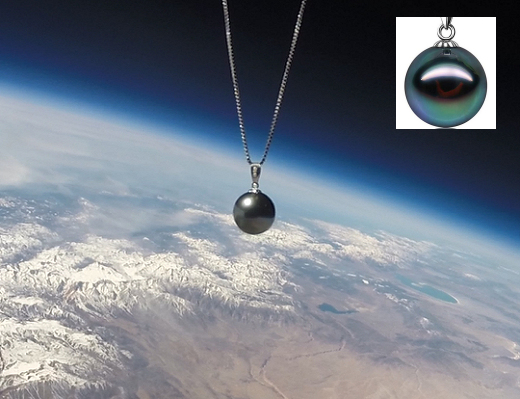
You can have it for $219.95. The students are selling these exotic space pearls to fund their cosmic ray monitoring program. Measuring 10 mm in diameter, the pearl has an 18K white gold clasp and is suspended from a matching 925 Sterling Silver chain. Each pearl comes with a greeting card showing the pendant in flight and telling the story of its journey to the edge of space.
Far Out Gifts: Earth to Sky Store
All sales support hands-on STEM education
Realtime Aurora Photo Gallery
Free: Spaceweather.com Newsletter