NOAA'S DSCOVR SATELLITE IS OPERATING AGAIN: NOAA's Deep Space Climate Observatory (DSCOVR) satellite, which had been offline for about nine months due to a technical glitch, is fully operational again. During the outage, we have been using solar wind data from NASA's older ACE spacecraft to issue space weather alerts. Now DSCOVR resumes its primary role in solar wind monitoring. Aurora alerts: SMS Text.
A SUNSPOT FROM THE NEXT SOLAR CYCLE: A new sunspot is emerging in the sun's southern hemisphere, and it looks like a member of new Solar Cycle 25. Numbered "AR2758," the sunspot is inset in this magnetic map of the sun's surface from NASA's Solar Dynamics Observatory:
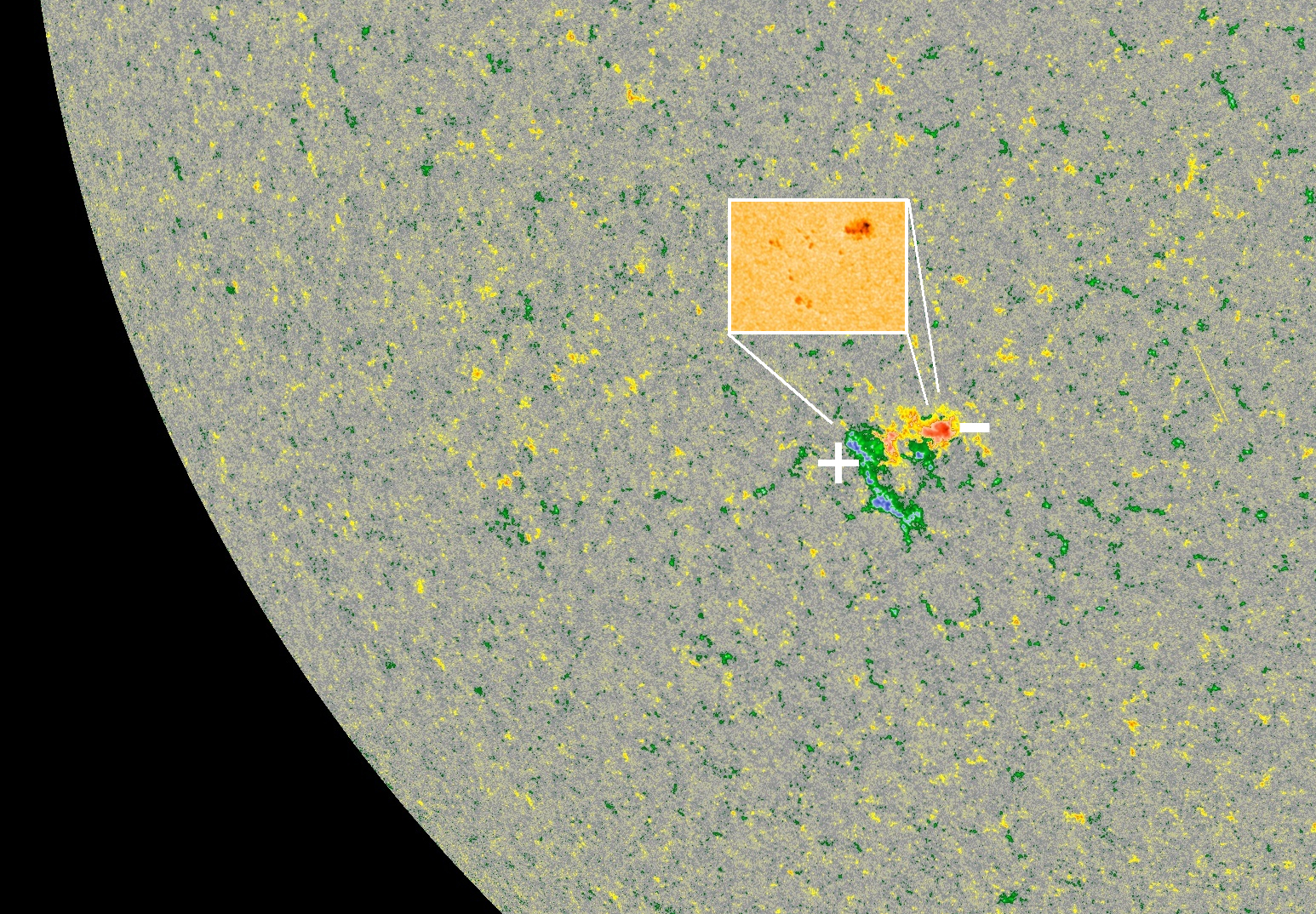
How do we know this sunspot belongs to Solar Cycle 25? Its magnetic polarity tells us so. Southern sunspots from old Solar Cycle 24 have a -/+ polarity. This sunspot is the opposite: +/-. According to Hale’s Law, sunspots switch polarities from one solar cycle to the next. AR2744 is therefore a member of Solar Cycle 25.
AR2758 continues a trend of increasing Solar Cycle 25 activity. So far this year, there have been 4 numbered sunspots. Three of them (75%) have been from Solar Cycle 25. This compares to only 17% in 2019 and 0% in 2018. Solar Cycle 25 is still weak, but it is coming.
SHORTWAVE SOLAR RADIO BURSTS: Sunspot AR2758 has produced one of the first solar radio bursts of Solar Cycle 25. "I was surprised to see distinct solar radio bursts on my spectrograph this morning," reports Thomas Ashcraft. Click to play the slow-rolling roar of static that emerged from the loudspeakers of his amateur radio telescope in New Mexico:
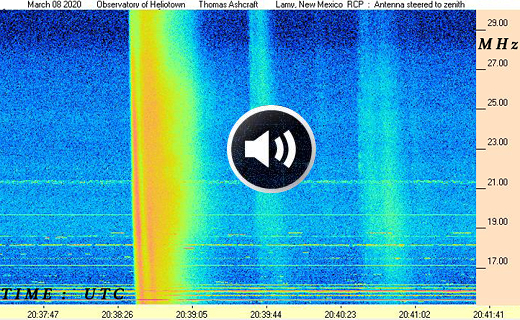
These radio sounds are caused by beams of electrons--in this case, accelerated by unrest in the sunspot's fast-changing magnetic canopy. As the electrons slice through the sun's atmosphere, they generate a ripple of plasma waves and radio emissions detectable on Earth 93 million miles away. Astronomers classify solar radio bursts into five types; Ashcraft's recording captured a mixture of Type III and Type V.
"Even in the height of solar maximum, this would be considered a strong solar burst," says Ashcraft, who has been listening to solar radio many years. "I am hoping for more!"
Extra: There is growing evidence that solar radio bursts can disorient the navigation of grey whales, causing them to strand on beaches. According to the radical-pair hypothesis of magnetoreception, shortwave bursts such as the one Ashcraft recorded may be especially effective at sending them off course.
Realtime Space Weather Photo Gallery
Free: Spaceweather.com Newsletter
A BLACK PEARL IN THE STRATOSPHERE: It came from Tahiti--and now it's been to the edge of space. On Feb. 27, 2020, this genuine Black Tahitian South Sea Cultured Pearl flew to the stratosphere onboard an Earth to Sky Calculus cosmic ray balloon, soaring more than 100,000 feet above the Sierra Nevada mountains of central California:
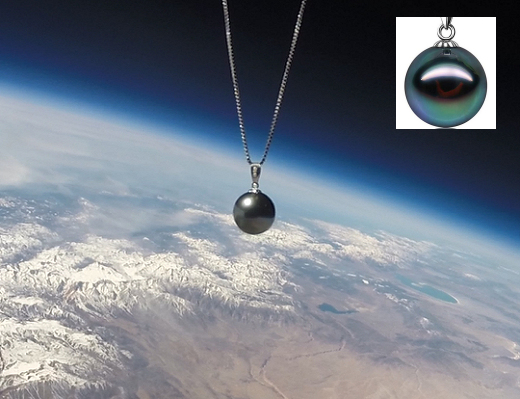
You can have it for $219.95. The students are selling these exotic space pearls to fund their cosmic ray monitoring program. Measuring 10 mm in diameter, the pearl has an 18K white gold clasp and is suspended from a matching 925 Sterling Silver chain. Each pearl comes with a greeting card showing the pendant in flight and telling the story of its journey to the edge of space.
Far Out Gifts: Earth to Sky Store
All sales support hands-on STEM education
Realtime Aurora Photo Gallery
Free: Spaceweather.com Newsletter