A 'RADIO-ACTIVE' SUNSPOT: New-cycle sunspot AR2758 announced itself with a roar on March 8th when it bubbled up from beneath the sun's surface and emitted a series of strong shortwave radio bursts. One of the static-y outbursts was very strong, rivaling bursts typically recorded during Solar Maximum. Listen to it here.
A QUIET WAVE IN EARTH'S MAGNETOSPHERE: On March 8th, a low hum rippled through Earth's magnetic field. It lasted for more than 2 hours, and caused compass needles in the Arctic to wave back and forth a tenth of a degree. Rob Stammes recorded the event from his magnetic observatory at the Polarlightcenter in Lofoten, Norway:

"When Earth's magnetic field is quiet (as it has been lately) sometimes very interesting things can be seen on my instruments," says Stammes. "In this case we recorded pulsations with a remarkably low frequency--about 7 minutes between pulses."
What are these waves? Imagine blowing across a piece of paper, making it flutter with your breath. Solar wind can have a similar effect on magnetic fields. The waves Stammes recorded are essentially flutters propagating down the flanks of Earth's magnetosphere excited by the breath of the sun.
Researchers call such waves "pulsations continuous" or "Pc" for short. Pc waves are classified into 5 types depending on their period. These fall into the range 150 to 600 seconds--that is, Pc5. Slow Pc5 waves have been linked to a loss of particles from the van Allen radiation belts. Energetic electrons can actually surf these waves down into Earth's atmosphere, where they dissipate harmlessly.
Detecting these delicate waves requires extraordinary quiet--like sitting in a silent room and hearing a pin drop. Solar Minimum makes this possible. At the moment, Earth's magnetic field is so still, magnetometers can pick up delicate waves that would otherwise be drowned out by the normal hub-bub of geomagnetic activity.
Realtime Space Weather Photo Gallery
Free: Spaceweather.com Newsletter
A BLACK PEARL IN THE STRATOSPHERE: It came from Tahiti--and now it's been to the edge of space. On Feb. 27, 2020, this genuine Black Tahitian South Sea Cultured Pearl flew to the stratosphere onboard an Earth to Sky Calculus cosmic ray balloon, soaring more than 100,000 feet above the Sierra Nevada mountains of central California:
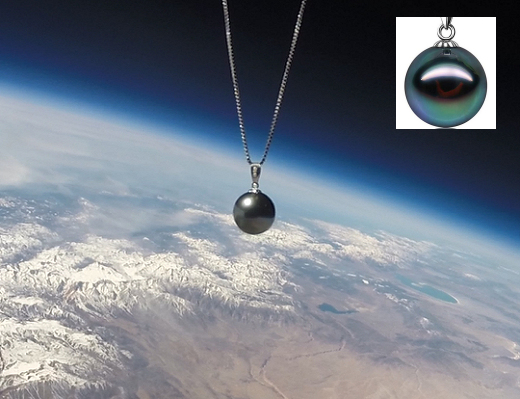
You can have it for $219.95. The students are selling these exotic space pearls to fund their cosmic ray monitoring program. Measuring 10 mm in diameter, the pearl has an 18K white gold clasp and is suspended from a matching 925 Sterling Silver chain. Each pearl comes with a greeting card showing the pendant in flight and telling the story of its journey to the edge of space.
Far Out Gifts: Earth to Sky Store
All sales support hands-on STEM education
Realtime Aurora Photo Gallery
Free: Spaceweather.com Newsletter