AURORAS LOVE EQUINOXES: The northern vernal equinox is only one week away. That's good news for Arctic sky watchers because auroras love equinoxes. Researchers call it the "Russell-McPherron effect." At this time of year, cracks form in Earth's magnetic field, allowing solar wind to enter. Even a weak stream of solar wind can spark a good display around the poles. Happy Spring! Aurora alerts: SMS Text.
NEW ATMOSPHERIC RADIATION MEASUREMENTS: We're back from the Arctic, and we have some new results to share. In January 2020, the students of Earth to Sky Calculus and Spaceweather.com traveled to Abisko, Sweden, to launch a pair of cosmic ray balloons. We'd been there before, launching three identical balloons in March 2017. Putting all the data together, 2017+2020, we find that radiation has increased +12% in the past 3 years:

The graph shows radiation dose rate (uGy/hr) vs. altitude (feet) all the way from ground level to the stratosphere. Radiation appears to be increasing at nearly all altitudes--even in the range 25,000 ft to 40,000 ft where airplanes fly. Polar flight crews and passengers are therefore absorbing ~12% more cosmic radiation than they did only a few years ago.
What's causing the increase? Solar Minimum. At the moment, the sun is near the bottom of the 11-year solar cycle. During Solar Minimum, the sun's magnetic field weakens, allowing extra cosmic rays from deep space to penetrate the solar system. These cosmic rays are hitting Earth's atmosphere, creating a spray of secondary cosmic rays that shower toward the ground below.
Secondary cosmic rays are what we measure. Radiation sensors onboard our helium balloons detect X-rays and gamma-rays in the energy range 10 keV to 20 MeV, similar to what you get from medical X-ray machines and airport security scanners.
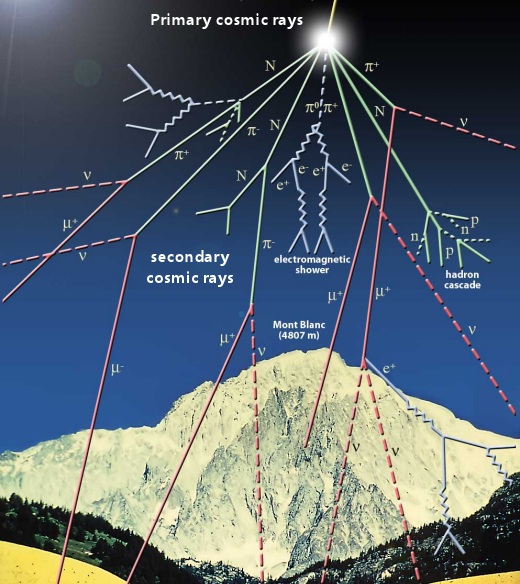
Above: Schematic diagram of a cosmic ray air shower. Learn more from CERN.
We've been launching radiation sensors almost weekly for 5 years--mainly from California, the "home base" of Spaceweather.com. Cosmic rays in the stratosphere have been increasing the entire time, a sign of deepening Solar Minimum.
The new data from Abisko, Sweden, show the increase is not limited to the stratosphere. It is also happening at aviation altitudes with a 3-year increase of ~12% even below 40,000 ft. We're planning another ballooning trip to Sweden in August 2020 to confirm these results. Stay tuned.
Realtime Space Weather Photo Gallery
Free: Spaceweather.com Newsletter
MR. SPOCK BOBBLEHEAD IN THE STRATOSPHERE: If you would like to support the Earth to Sky Calculus cosmic ray ballooning program, there's a logical way to do it. Puchase this Mr. Spock collector's item. Here is the green-blooded science officer floating 32.2 km (112,200 ft) above Death Valley National Park in central California:
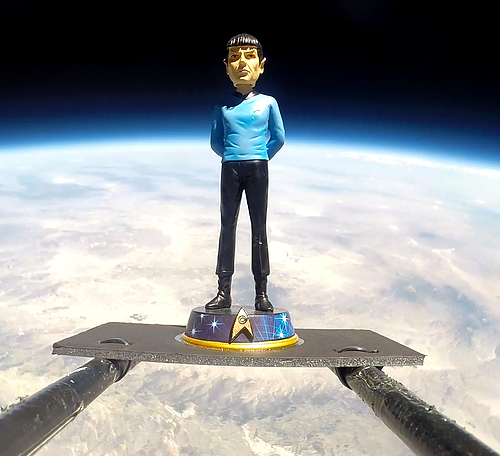
You can have him for $170.10. The price, in case you're wondering, is the serial number of the Enterprise, NGC1701, divided by 10. The students are selling Spock to buy more helium! He comes with a greeting card showing the high-quality resin bobblehead in flight and telling the story of his journey to the stratosphere and back again.
Far Out Gifts: Earth to Sky Store
All sales support hands-on STEM education
Realtime Aurora Photo Gallery
Free: Spaceweather.com Newsletter