SOLAR WIND, INCOMING: Will Arctic skies turn green on the first day of spring? It could happen. A minor stream of solar wind is due to hit Earth's magnetic field on March 19th, possibly causing auroras around the Arctic Circle. The gaseous material is flowing from a newly-opened hole in the sun's atmosphere. Aurora alerts: SMS Text.

AURORAS OVER FINLAND: Earth's magnetic field is cracking up. No, really. During weeks around equinoxes, cracks form in our planet's magnetosphere. Solar wind slips through the gaps, igniting auroras like these:

"What a great night to be in the Finnish Lapland!" says Rayann Elzein of Utsjoki, Finland, who took the picture on March 16th. "Auroras danced overhead for hours, at one point covering about 80% of the sky."
This seasonal phenomenon is called the "Russell-McPherron effect" after the space physicists who first described it. Around the beginning of Spring, the interplanetary magnetic field (IMF) can link up with Earth's own magnetic field, prying open cracks. In the jargon of space weather forecasting, we say "BsubZ tips south" or has "gone negative."
"BsubZ was negative most of the night, sparking beautiful green auroras with a hint of purple," says Elzein. Happy Spring!
Realtime Aurora Photo Gallery
Free: Spaceweather.com Newsletter
HIGH-RESOLUTION SPACE STATION: Amateur astronomer Philip Smith long ago established himself as one of the world's finest photographers of the International Space Station (ISS). Whenever the ISS zips over his backyard in Manorville, New York, Smith is usually outside waiting to SNAP! a high-resolution image. On March 12th he outdid even his own high standards:

"I've presented the image as both positive and negative to improve visibility of some components," says Smith, who used a heavily instrumented 14-inch telescope, its clock drive whirring rapidly to keep up with the fast-moving spaceship. This video shows how the viewing angle changed as his optics tracked the ISS across the sky.

Smith has labeled more than 2 dozen modules and sub-systems of the ISS--some of them as small as a few meters across (e.g., the Cupola). Also shown are no fewer than 4 docked spaceships: SpaceX's Dragon CRS-20, Northrop Grumman's Cygnus NG-13 cargo ship, and Russia's Soyuz MS-15 and Progress 74 vessels. It's busy up there! And it's busy in some New York backyards. Browse the Spaceweather Photo Gallery for more of Smith's images.
Realtime Space Weather Photo Gallery
Free: Spaceweather.com Newsletter
MR. SPOCK BOBBLEHEAD IN THE STRATOSPHERE: If you would like to support the Earth to Sky Calculus cosmic ray ballooning program, there's a logical way to do it. Puchase this Mr. Spock collector's item. Here is the green-blooded science officer floating 32.2 km (112,200 ft) above Death Valley National Park in central California:
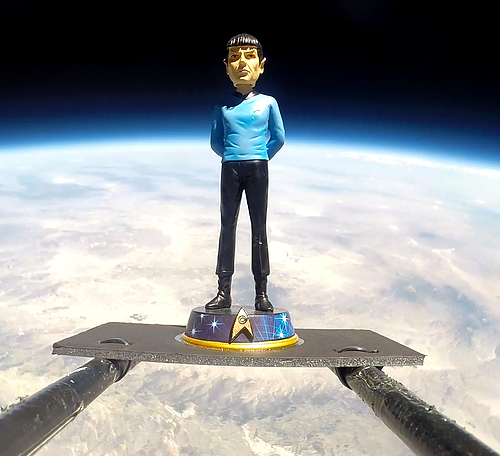
You can have him for $170.10. The price, in case you're wondering, is the serial number of the Enterprise, NGC1701, divided by 10. The students are selling Spock to buy more helium! He comes with a greeting card showing the high-quality resin bobblehead in flight and telling the story of his journey to the stratosphere and back again.
Far Out Gifts: Earth to Sky Store
All sales support hands-on STEM education