IT'S SPRING! AND THE SOLAR WIND IS BLOWING: Today is the first day of northern spring and, as predicted, Earth is entering a stream of solar wind. The gaseous material is flowing from a newly-opened hole in the sun's atmosphere. Arctic sky watchers should be alert for green skies at midnight. Aurora alerts: SMS Text.

COMET ATLAS IS BRIGHTENING FASTER THAN EXPECTED: Get ready for a wild ride. Comet ATLAS (C2019 Y4) is plunging toward the sun and, if it doesn't fly apart first, it could become one of the brightest comets in years.
"Comet ATLAS continues to brighten much faster than expected," says Karl Battams of the Naval Research Lab in Washington DC. "Some predictions for its peak brightness now border on the absurd."
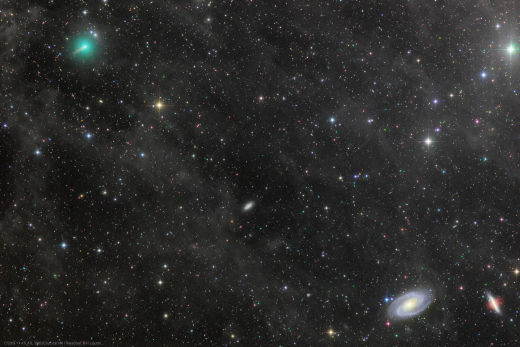
Above: Comet Atlas (upper left) glides by spiral galaxy M81 on March 18th. Credit: Rolando Ligustri [more]
The comet was discovered in December 2019 by the Asteroid Terrestrial-impact Last Alert System (ATLAS) in Hawaii. Astronomers quickly realized it might be special. On May 31, 2020, Comet ATLAS will pass deep inside the orbit of Mercury only 0.25 AU from the sun. If it can survive the blast furnace of solar heating, it could put on a good show.
However, no one expected the show to start this soon. More than 2 months before perihelion (closest approach to the sun), Comet ATLAS is already "heating up." The worldwide Comet Observation Database shows it jumping from magnitude +17 in early February to +8 in mid-March–a 4000-fold increase in brightness. It could become visible to the naked eye in early April.
"Right now the comet is releasing huge amounts of its frozen volatiles (gases)," says Battams. "That’s why it’s brightening so fast."
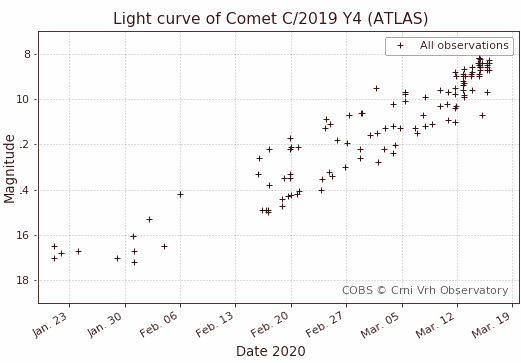
Can ATLAS sustain this crazy pace? If it has a big nucleus w ith large stores of frozen gas, then yes; we could get a very bright comet. Otherwise, Comet ATLAS might run out of gas, crumbling and fading as it approaches the sun.
Current best estimates of the comet’s peak brightness in May range from magnitude +1 to -5. If Comet ATLAS hits the high end of that range, a bit brighter than Venus, it could become visible in broad daylight.
Comet McNaught (C/2006 P1) performed that very trick 13 years ago. On Jan. 13, 2007, it swooped past the sun shining at magnitude -5. The absurdly-bright comet was visible at high noon with its tail jutting across blue sky:

Above: Comet McNaught in broad daylight on Jan. 13, 2007. Photo credit: Peter Rosen. [more]
Battams is not optimistic, though: "My personal intuition is that Comet ATLAS is over-achieving, and I wouldn’t be surprised to see it fade rapidly and possibly even disintegrate before reaching the sun," he says.
Come to think of it, that would be a good show, too. Fortunately, NASA has spacecraft with cameras that specialize in seeing things close to the sun.
"The Heliospheric Imager on NASA's STEREO spacecraft will get a great view of ATLAS from mid-May through early June," says Battams. "The camera is very sensitive, so we might be able to observe ATLAS’s tail interacting with the solar wind and outflows–as well as any potential breakup events."
Stay tuned!
Realtime Space Weather Photo Gallery
Free: Spaceweather.com Newsletter
MR. SPOCK BOBBLEHEAD IN THE STRATOSPHERE: If you would like to support the Earth to Sky Calculus cosmic ray ballooning program, there's a logical way to do it. Puchase this Mr. Spock collector's item. Here is the green-blooded science officer floating 32.2 km (112,200 ft) above Death Valley National Park in central California:
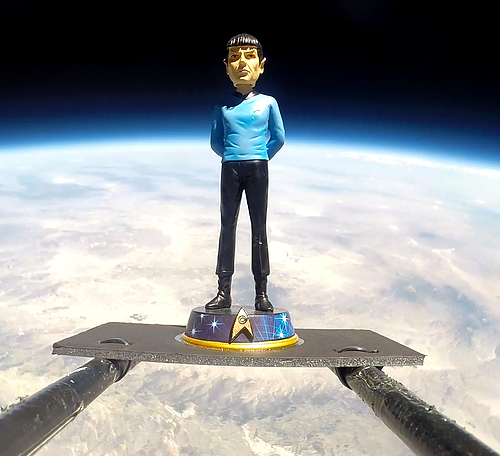
You can have him for $170.10. The price, in case you're wondering, is the serial number of the Enterprise, NGC1701, divided by 10. The students are selling Spock to buy more helium! He comes with a greeting card showing the high-quality resin bobblehead in flight and telling the story of his journey to the stratosphere and back again.
Far Out Gifts: Earth to Sky Store
All sales support hands-on STEM education
Realtime Aurora Photo Gallery
Free: Spaceweather.com Newsletter