SOLAR MINIMUM CONDITIONS ARE IN EFFECT: The sun has been blank (no sunspots) for 11 consecutive days--a sign that Solar Minimum is still underway. During this quiet phase of the solar cycle, space weather is calm and the chance of a solar flare is very low. However, even improbable things happen sometimes. For more on this, see below. Aurora alerts: SMS Text.
AN EXPLOSION ON THE FARSIDE OF THE SUN: Solar Minimum is not as quiet as you think. On March 20th, something exploded on the farside of the sun. The Solar and Heliospheric Observatory (SOHO) saw the debris flying over the sun's eastern limb:

The blast site was hidden from view, so we don't know what exploded. It probably wasn't a sunspot. Sunspots have been extremely scarce for the past two years. More likely, a filament of magnetism became unstable and erupted, hurling bits of itself and surrounding plasma into space.
The resulting coronal mass ejection (CME) will miss Earth. But consider this: If the exposion had occured only a couple weeks later, when the blast site would be facing Earth, we would now be bracing for a moderately strong geomagnetic storm. Maybe next time! Aurora alerts: SMS Text.
Realtime Aurora Photo Gallery
Free: Spaceweather.com Newsletter
AURORAS BEFORE DARK: The first night of northern spring was a good one for sky watchers in Norway. In fact, the auroras didn't even wait until nightfall. "We saw them dancing even before it got dark in Senja!" reports Matt Robinson, who took this picture from his front yard:

"Auroras danced for nearly 3 hours and gave us some beautiful colours." he says. "The equinox lived up to its promise."
It's true. Auroras love equinoxes. At this time of year, the interplanetary magnetic field (IMF) can link up with Earth's magnetic field, prying open cracks. Solar wind pours in to fuel displays of aurora borealis--no geomagnetic storm required. Researchers call this the Russell-McPherron effect after the space physicists who first described it in the 1970s.
Realtime Space Weather Photo Gallery
Free: Spaceweather.com Newsletter
MR. SPOCK BOBBLEHEAD IN THE STRATOSPHERE: If you would like to support the Earth to Sky Calculus cosmic ray ballooning program, there's a logical way to do it. Puchase this Mr. Spock collector's item. Here is the green-blooded science officer floating 32.2 km (112,200 ft) above Death Valley National Park in central California:
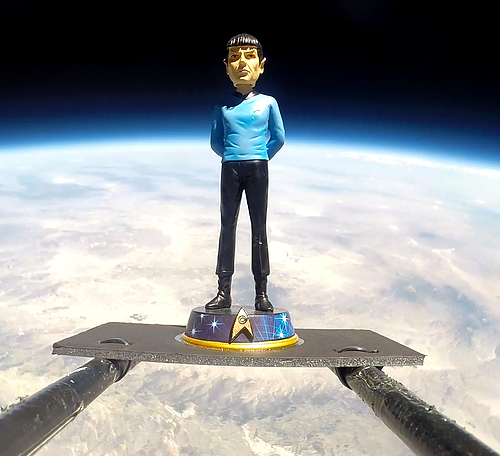
You can have him for $170.10. The price, in case you're wondering, is the serial number of the Enterprise, NCC1701, divided by 10. The students are selling Spock to buy more helium! He comes with a greeting card showing the high-quality resin bobblehead in flight and telling the story of his journey to the stratosphere and back again.
Far Out Gifts: Earth to Sky Store
All sales support hands-on STEM education