WHERE DID ALL THE SUNSPOTS GO? So far this year, the sun has been blank--without sunspots--76% of the time. That's verging on the Space Age record set just last year in 2019 when the sun was blank 77% of the time. This means Solar Minimum is still underway despite recent signs of life from the next solar cycle. Stay tuned for more quiet. Aurora alerts: SMS Text.
THE SIZE OF COMET ATLAS: No one knows how big the icy core of Comet ATLAS (C/2019 Y4) might be. Possibly, it's no wider than a few kilometers. One thing's for sure, the comet's atmosphere is huge. New images from amateur astronomers around the world show that ATLAS's gaseous envelope has ballooned in diameter to ~720,000 km--about half as wide as the sun.

"Comet ATLAS's coma (atmosphere) is approximately 15 arcminutes in diameter," reports Michael Jäger of Weißenkirchen, Austria, who took the picture, above, on March 18th. "Its newly-formed tail is about the same size."
Other astronomers are getting similar results. 15 arcminutes equals a quarter of a degree. Given Comet ATLAS's distance of 1.1 AU on March 18th, that angle corresponds to a physical size of 720,000 km.
On the scale of big things in the solar system, Comet ATLAS falls somewhere between the sun (1,392,000 km diameter) and Jupiter (139,820 km). It's not unusual for comets to grow this large. While their icy solid cores are typically mere kilometers in diameter, they can spew prodigious amounts of gas and dust into space, filling enormous volumes with their gossamer exhaust. In the fall of 2007, Comet 17P/Holmes partially exploded and, for a while, had an atmosphere even larger than the sun. The Great Comet of 1811 also had a sun-sized coma. Whether Comet ATLAS will eventually rival those behemoths of the past remains to be seen.
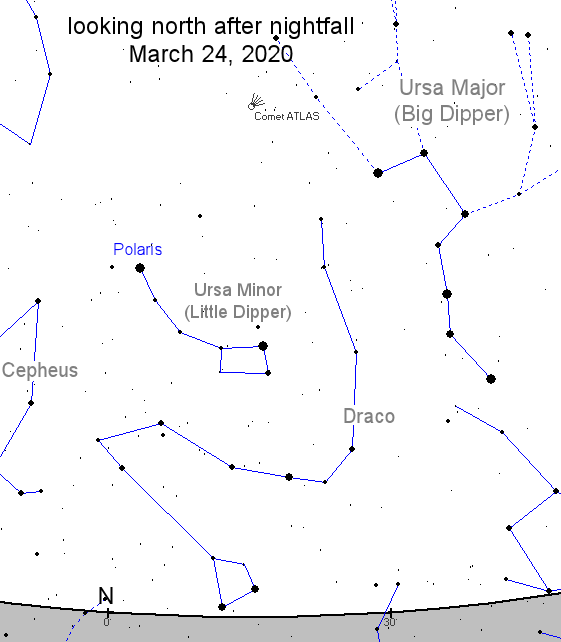
Right now, Comet ATLAS is certainly the biggest green thing in the Solar System. Its verdant hue comes from diatomic carbon, C2, a common molecule in comets. Gaseous C2 emits a beautiful green glow in the near-vacuum of space. This green color could become visible to the naked eye in mid-April as Comet ATLAS moves closer to Earth and the sun. Stay tuned!
Realtime Comet ATLAS Photo Gallery
Free: Spaceweather.com Newsletter
IT CAME FROM SPACE--THE INFINITY PENDANT: Are you looking for a far-out gift? Nothing says "I Love You" like an Infinity Pendant from the edge of space. On Jan. 8, 2020, the students of Earth to Sky Calculus launched a cosmic ray balloon. This authentic Swarovski crystal pendant hitched a ride, traveling 113,209 feet above the Sierra Nevada mountains of central California
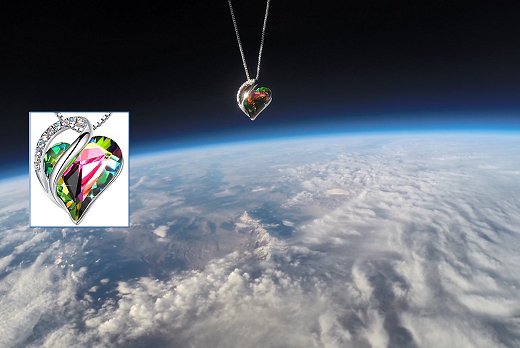
You can have it for $179.95. The students are selling these pendants to support their cosmic ray ballooning program. The glittering heart-shaped crystal is wrapped in a silver-embossed infinity clasp, symbolizing unending love. Each one comes with a romantic card showing the pendant in flight and telling the story of its journey to the edge of space and back again.
Far Out Gifts: Earth to Sky Store
All sales support hands-on STEM education
STAR TRAILS VS. STARLINK TRAILS: Since the invention of photography, amateur astronomers have enjoyed taking pictures of startrails--long lazy arcs that stars make as they pirouette around the North Celestial Pole. Lately, startrails have competition. Last week, Debra Ceravolo photographed a spray of Starlink satellite trails crisscrossing the real stars over British Columbia:

"This mess is from just one group of Starlink satellites," says Ceravolo. "Just imagine what it will be like when they launch 20,000+?"
Starlink is a new venture by SpaceX. Elon Musk's rocket company plans to launch tens of thousands of satellites, surrounding Earth with transmitters that can bring internet to almost every part of our planet. So far, SpaceX has launched a relatively few 360, a fraction of which appear in Ceravolo's photo. Just imagine, indeed.
Realtime Space Weather Photo Gallery
Free: Spaceweather.com Newsletter
Realtime Aurora Photo Gallery
Free: Spaceweather.com Newsletter