THE SUN IS BLANK, REALLY BLANK: 2019 set a Space Age record for spotless days. The sun was blank 77% of the time last year. 2020 is on the same pace. So far this year, the sun has also been without sunspots 77% of the time. Will Solar Minimum never end? Forecasters believe sunspot counts will begin to increase again in late 2020. Aurora alerts: SMS Text.

NOCTILUCENT CLOUDS OVER THE SOUTH PACIFIC: You don't see this everyday–or even in 30 years. "Noctilucent clouds (NLCs) have appeared over the South Pacific," reports meteorologist Ashleigh Wilson of the Australian Antarctic Division. "I photographed them from Macquarie Island on Jan. 4th."

Wilson is just wrapping up a year-long stint on the remote island where the Australian government maintains a research station to study climate change and wildlife. "According to John French of the Australian Antarctic Division Atmospheric Science Program, the only other photographic recording of NLCs from Macquarie Island was in the mid-1990s," she says.
NLCs are Earth's highest clouds. Seeded by meteoroids, they float at the edge of space more than 80 km above the planet’s surface. NLCs form when summertime wisps of water vapor rise up to the edge of space and crystalize around specks of 'meteor smoke.' Prime time for sightings is June-July in the north, December-January in the south.
"It was a breathtaking moment when I first realized what I was seeing," recalls Wilson. "I spent two hours down by the ocean with a camera and tripod, adjusting ISO and lenses, trying to capture the extraordinary event. The clouds were so bright, I could see their reflection in the water."
Wilson's sighting caps a remarkable year for noctilucent clouds. Once confined to Earth's polar regions, NLCs have recently spread to lower and lower latitudes. In June 2019, the clouds appeared over Rome, Italy; Las Vegas, Nevada; Albuquerque, New Mexico; Paris, France; and outside Los Angeles, California. Many of the sightings smashed old records for low-latitude visibility.

Above: The spread of NLCs. Their traditional domain is shaded. Black circles denote sightings in 2003-2011. Red circles are for June 2019. The map originally appeared in JGR Atmospheres: article.
In the southern hemisphere, reports of any noctilucent clouds are quite rare–in part because there are fewer people on that side of the world; in part because southern NLCs are usually weaker than their northern counterparts. Nevertheless, NLCs were sighted over New Zealand in Dec. 2019 and Macquarie Island in Jan. 2020.
No one knows why NLCs are so revved up. It could be a result of climate change and/or the solar cycle. Whatever the reason, get ready for more. The northern hemisphere season for NLCs is about to begin. Typically, the first electric-blue filaments are sighted in mid- to late-May followed by a sharp intensification in June. If recent trends continue, summer 2020 could be very special indeed.
A longer and sharable version of this story may be found here.
Realtime Noctilucent Cloud Photo Gallery
Free: Spaceweather.com Newsletter
FAR-OUT MOTHER'S DAY GIFT: Every time the students of Earth to Sky Calculus launch cosmic ray sensors to the stratosphere, they send a little something extra along for the ride. For example, this Northern Lights pendant:
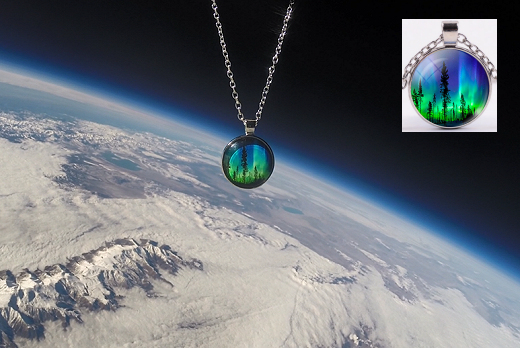
On Dec. 6, 2019, it flew 107,612 feet above the rugged Sierra Nevada mountains of central California.
You can have it for $129.95. The students are selling these pendants as a fund-raiser for their cosmic ray monitoring program. They make great anniversary, birthday and Mother's Day gifts. Each pendant comes with a greeting card showing the jewelry in flight and telling the story of its journey to the stratosphere and back again.
Far Out Gifts: Earth to Sky Store
All sales support hands-on STEM education
Realtime Space Weather Photo Gallery
Free: Spaceweather.com Newsletter
Realtime Aurora Photo Gallery
Free: Spaceweather.com Newsletter