THE SOLAR WIND HAS ARRIVED: As predicted, a stream of solar wind is buffeting Earth's magnetic field today, March 30th. Full-fledged geomagnetic storms are not expected, but the action of the solar wind could spark dynamic auroras around the Arctic Circle. The gaseous material is slowing from a southern hole in the sun's atmosphere. Aurora alerts: SMS Text.

A SUNSPOT FROM THE NEXT SOLAR CYCLE: A sunspot is emerging over the sun's northeastern limb, and it appears to be a member of the next solar cycle. The unnumbered active region is inset in this magnetic map of the sun's surface from NASA's Solar Dynamics Observatory:

How do we know this sunspot belongs to the next solar cycle? Its magnetic polarity tells us so. Northern sunspots from old Solar Cycle 24 have a +/- polarity. This sunspot appears to be the opposite: -/+. According to Hale’s Law, sunspots switch polarities from one solar cycle to the next. The sunspot is therefore a member of Solar Cycle 25.
This new active region continues a trend of increasing Solar Cycle 25 activity. So far this year, there have been 4 officially-numbered sunspots. Three of them (75%) have been from Solar Cycle 25. This compares to only 17% in 2019 and 0% in 2018. Solar Cycle 25 is still weak, but it is coming.
Realtime Space Weather Photo Gallery
Free: Spaceweather.com Newsletter
FAR-OUT MOTHER'S DAY GIFT: It’s sterling silver and perfect for Mother’s Day! On March 5th, the students of Earth to Sky Calculus flew a cosmic ray balloon to the stratosphere, more than 94,000 feet above Earth's surface. This "Loving Hands" pendant went along for the ride:
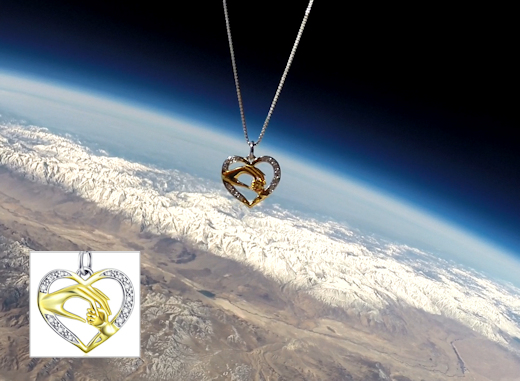
You can have one for $129.95. The students are selling these pendants as a fund-raiser for their cosmic ray monitoring program. All proceeds support atmospheric radiation measurements and hands-on STEM education. Each pendant comes with a greeting card showing the jewelry in flight and telling the story of its journey to the stratosphere and back again.
Far Out Gifts: Earth to Sky Store
All sales support hands-on STEM education
SATURDAY NIGHT SKY SHOW: Saturday night was a good time to be outside. Just after sundown, the crescent Moon joined Venus and the Pleiades for a rare 3-way conjunction in the western sky. Mark A. Brown photographed the display from Troy Mills, Iowa:

"Venus continues to shine like a silvery-white beacon in the western sky, not setting for about 3 hours after sundown," says Brown. "On March 28th, the lovely crescent Moon joined the bright planet at dusk, making for an eye-catching pair of celestial jewels alongside the delicate Pleiades."
And, of course, "two Starlink satellites photobombed my exposure," he adds. "In the image above they are cutting through the windmill."
Saturday night's conjunction sets the stage for an even rarer event next weekend. Every night this week, Venus and the Pleiades will inch closer and closer together until, on April 3rd, Venus is actually inside the star cluster. It's the kind of conjunction that only happens once every 8 years. Don't miss it! Sky maps: March 28, 29, 30, 31, April 1, 2, 3.


Realtime Space Weather Photo Gallery
Free: Spaceweather.com Newsletter
Realtime Aurora Photo Gallery
Free: Spaceweather.com Newsletter