A SUNSPOT FROM THE NEXT SOLAR CYCLE: A new sunspot is emergingin the sun's northern hemisphere, right here. Its magnetic polarity identifies it as a member of new Solar Cycle 25. If the sunspot lasts long enough to receive an official designation, it will become the 4th numbered new-cycle sunspot this year, a sign that Solar Cycle 25, while still weak, is gaining steam. Aurora alerts: SMS Text.

SOLAR WIND SPARKS SPRINGTIME AURORAS: A solar wind stream hit Earth's magnetic field on March 30th, sparking dynamic auroras around the Arctic Circle. The lights descended all the way to southern Sweden where Lukasz Asz witnessed the display from Gaddesanna beach:

"We went to Vanern lake to see Venus with the Moon next to it," says Asz. "The amazing green glare of Northern Lights came as a surprise. They are not that common in the south of Sweden."
The solar wind stream is flowing ~500 km/s from a southern hole in the sun's atmosphere. The hole is wide enough, just barely, to give us an additional day of elevated solar wind speeds. Arctic sky watchers should remain alert for auroras on March 31st. Aurora alerts: SMS Text.
Realtime Aurora Photo Gallery
Free: Spaceweather.com Newsletter
FLOATING LIGHT PILLARS: Not everything that looks like an aurora actually is an aurora. Here's an example. On March 28th, Jocelyn Blanchette photographed dozens of colorful light pillars floating above Fermont, Quebec, Canada:

Light pillars are caused by ice crystals in the air which intercept manmade lights and spread them into colorful columns. Red-orange hues are due to high pressure sodium lamps, while modern LED lamps create blue-white pillars. No solar activity is required for the phenomenon. The only ingredients are ice and light pollution.
Most light pillars spring up from the ground where urban lights are located. These 'floating' pillars are more unusual. The instigating crystals must have been high above the ground, increasing their resemblence to auroras.
Realtime Space Weather Photo Gallery
Free: Spaceweather.com Newsletter
A BLACK PEARL IN THE STRATOSPHERE: It came from Tahiti--and now it's been to the edge of space. On Feb. 27, 2020, this genuine Black Tahitian South Sea Cultured Pearl flew to the stratosphere onboard an Earth to Sky Calculus cosmic ray balloon, soaring more than 100,000 feet above the Sierra Nevada mountains of central California:
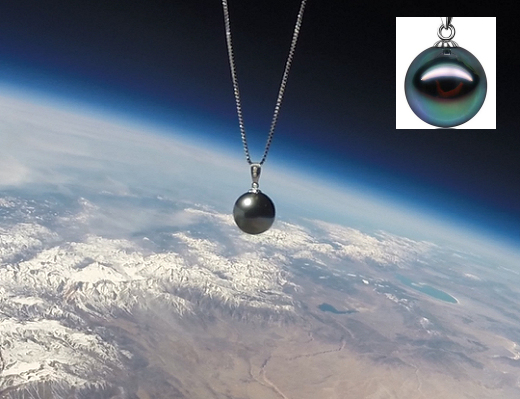
You can have it for $229.95. The students are selling these exotic space pearls to fund their cosmic ray monitoring program. Measuring 10 mm in diameter, the pearl has an 18K white gold clasp and is suspended from a matching 925 Sterling Silver chain. Each pearl comes with a greeting card showing the pendant in flight and telling the story of its journey to the edge of space.
Far Out Gifts: Earth to Sky Store
All sales support hands-on STEM education
Realtime Aurora Photo Gallery
Free: Spaceweather.com Newsletter