FREE BALLOON FLIGHTS TO THE STRATOSPHERE: Hey, did your science class get cancelled? Are you stuck at home with nothing to do? Maybe now is the time to visit the stratosphere. We're giving away high-altitude balloon launches to students and citizen scientists who have good ideas for experiments. The program is called FREELIFT, and you're invited to participate.
COMET ATLAS MIGHT BE FRAGMENTING: Comet ATLAS (C/2019 Y4), what are you doing? New data from astronomers around the world show that the once-promising comet is beginning to fade. For Karl Battams of the Naval Research Lab in Washington DC, it could be a classic case of "I told you so."

Comet ATLAS on March 28th. Credit: Tim Connolly of Plattsburgh, NY. [More images]
"Quoting myself from March 15th," says Battams, "'I wouldn't be surprised to see Comet ATLAS start to fade rapidly and possibly even disintegrate before reaching the sun.' I very much hope I’m wrong, but Comet Elenin did something similar several years ago, holding lots of promise and then just… fizzling."
In recent months, Comet ATLAS galvanized astronomers as it fell toward the sun, skyrocketing in brightness like few comets before it. By late May 2020 it promised to rival Venus in the sunset sky. But recent developments belie that possibility.
On April 6th, astronomers Quanzhi Ye of the University of Maryland) and Qicheng Zhang of Caltech reported new images of Comet ATLAS, in which the comet's core appears to be elongating--"as would be expected from a major disruption of the nucleus," they wrote in an Astronomical Telegram.

Images from the 0.6-m Ningbo Education Xinjiang Telescope show a possible fragmentation of ATLAS's core
"It's possible that this is the beginning of the end," says Battams.
Recent measurements of the comet's position also point to trouble. Battams explains: "The comet's orbit is now being influenced by 'non-gravitational' forces. These forces are the result of gases lifting off the comet nucleus and causing the nucleus to move very slightly in the opposite direction--sort of like a jet engine. Most active comets experience this to some degree, but ATLAS's non-gravitational forces have kicked in very abruptly and are quite strong. This supports a narrative of a small nucleus being pushed very strongly by extreme outgassing, possibly along with fragmentation."
"Finally, let's not forget that ATLAS is a fragment of a larger (unidentified) comet also related to the Great Comet of 1844," says Battams. "Fragmenting is a family trait for these guys."
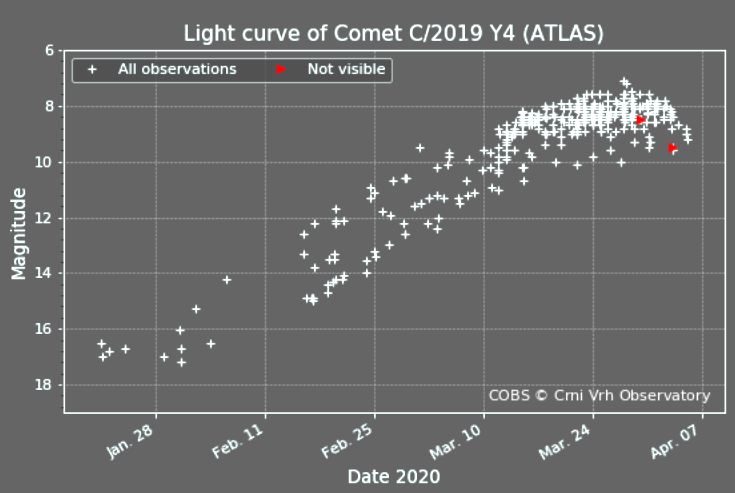
Is Comet ATLAS doomed? Not necessarily. "The frustrating thing about comets is we often don't know exactly what they're doing or why they're doing it. There's still a chance that Comet ATLAS is just 'taking a breather' before another outburst," says Battams. "But I wouldn't count on it...."
No matter what happens, amateur astronomers are encouraged to monitor developments. Submit your images here.
Realtime Space Weather Photo Gallery
Free: Spaceweather.com Newsletter
A MOTHER'S DAY GIFT FROM THE STRATOSPHERE: Are you looking for a far-out gift? Nothing says "I Love You" like an Infinity Pendant from the edge of space. On Jan. 8, 2020, the students of Earth to Sky Calculus launched a cosmic ray balloon. This authentic Swarovski crystal pendant hitched a ride, traveling 113,209 feet above the Sierra Nevada mountains of central California
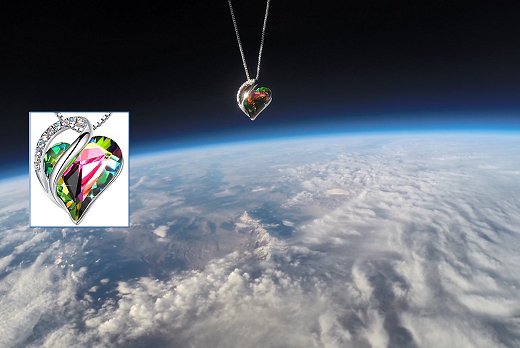
You can have it for $179.95. The students are selling these pendants to support their cosmic ray ballooning program. The glittering heart-shaped crystal is wrapped in a silver-embossed infinity clasp, symbolizing unending love. Each one comes with a romantic card showing the pendant in flight and telling the story of its journey to the edge of space and back again.
Far Out Gifts: Earth to Sky Store
All sales support hands-on STEM education
Realtime Aurora Photo Gallery
Free: Spaceweather.com Newsletter