THE SOLAR WIND HAS ARRIVED: An unexpected stream of solar wind is blowing around Earth on April 8th. The stream's velocity is only moderately high (~450 km/s) but it contains south-pointing magnetic fields that can open cracks in Earth's magnetosphere. Arctic sky watchers should be alert for auroras mixed with springtime twilight. Aurora alerts: SMS Text.
AURORA SURPRISE: Auroras were not in the forecast for April 7th. Nevertheless, they appeared in force over Utsjoki, Finland. "Despite the full moon, we witnessed a beautiful explosion of green, with the purple nitrogen fringe as well," reports Rayann Elzein who took this picture:

"We've reached the time of year when the northern horizon never gets totally dark," says Elzein. "Nevertheless, aurora season is not over yet!"
What caused the display? Unexpectedly, a crack opened in Earth's magnetic field. ("BZ tipped south.") Solar wind poured in to spark the lights.
Soon, the night sky will be too bright for Arctic observers to see auroras. " Just in case, I said 'goodbye' until September, but who knows, maybe we get more luck in the coming days," says Elzein. Indeed, more luck could be in the offing. A high-speed stream of solar wind is approaching Earth, flowing from a hole in the sun's atmosphere. Estimated time of arrival: April 10-11. Stay tuned.

Realtime Aurora Photo Gallery
Free: Spaceweather.com Newsletter
MINERAL MOON: According to folklore, last night's full Moon was the "Pink Moon," named after the first flowers of northern spring. A closer look reveals a number of other colors as well. Talha Zia sends this picture from Karachi, Pakistan:

No filter was required to produce Zia's image. The colors are naturally present and only need a bit of boosting with Photoshop to see. "I stacked 43 single images to enhance signal to noise ratio," says Zia, "then I enhanced the colors deliberately to create the final photo." The method is described here.
What do the colors mean? Blue denotes areas rich in titanium, while orange is titanium poor. Titanium-rich zones are particularly interesting because lunar titanium is bound to oxygen--for instance, in the lunar mineral ilmenite. This oxygen may be easily extracted, providing future explorers a source of air to breath and oxidizer for rocket engines.
Pink is present, too, in a type of rock called "pink spinel anorthosite." This is a mineral composed of aluminum, magnesium, and oxygen, and might be formed by melting when meteorites hit the Moon. Apollo astrononauts found it in Moon rocks, and researchers are still trying to figure out where it comes from.
Realtime Space Weather Photo Gallery
Free: Spaceweather.com Newsletter
A MOTHER'S DAY GIFT FROM THE STRATOSPHERE: Tell Mom how much you love her -- to the Moon and Back! On March 5th, the students of Earth to Sky Calculus launched an array of cosmic ray sensors to the edge of space onboard a helium balloon. This Mother's Day pendant went along for the ride:
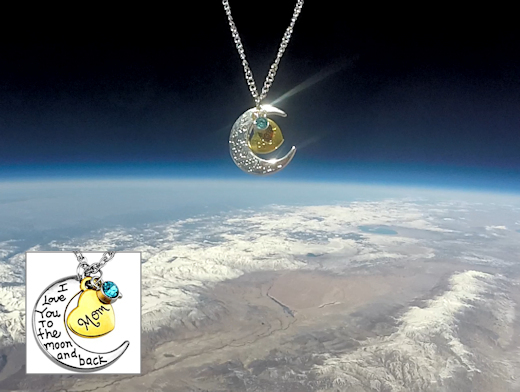
The silvery crescent declares "I love you to the Moon and Back" and surrounds a 14K gold plated heart labeled "Mom."
You can have it for $99.95. The students are selling these pendants to support their cosmic ray ballooning program. Each one comes with a greeting card showing the item in flight and telling the story of its journey to the edge of space. Sales support the Earth to Sky Calculus cosmic ray ballooning program and hands-on STEM research.
Far Out Gifts: Earth to Sky Store
All sales support hands-on STEM education
Realtime Aurora Photo Gallery
Free: Spaceweather.com Newsletter