SOLAR STORM ELECTRICAL HAZARD MAP: Power companies have long been wary of the sun. Why? Because solar superstorms can make your lights go out. A new map from the USGS shows places in the USA where a century-class storm could cause power outages. Find out if you're in the blackout zone.
DIAMOND DUST SUN HALO: It may be springtime, but the air in Sweden is still filled with ice. On April 11th the flying crystals caught the rays of the sun, bending them into a bright 22-degree halo. Göran Strand photographed the ring of light hovering over the mountains of Jämtland:

"Even the Parhelic Circle was visible," says Strand. "It was the perfect Easter present for me :-)"
The sharpness of this halo is a sign that the sun was shining through "diamond dust"--jewel-like ice crystals of exceptional purity that form in cold near-polar environments. Indeed, a close look at Strand's picture shows specks of light in the air. Those are the glittering crystals of diamond dust which make the halo so beautiful.

Realtime Space Weather Photo Gallery
Free: Spaceweather.com Newsletter
MERCURY PROBE FLIES PAST EARTH: Yesterday, April 10th, the ESA-JAXA BepiColombo spacecraft buzzed Earth. At closest approach, the probe was only 12,700 km above our planet. This sequence of images was taken by one of the BepiColombo's MCAM selfie cameras:

This maneuver, the first of nine planetary flybys but the only one at Earth, helped steer the spacecraft towards Venus as it gradually closes in on its target orbit around Mercury. During its seven-year cruise to Mercury, BepiColombo will twice use the gravity of Venus and six times that of Mercury to brake against the gravitational pull of the sun. So much braking would require more fuel than the small spacecraft can carry, so it is using this complicated series of reverse-slingshot maneuvers instead.
Another just-released video shows BepiColumbo approaching Earth:

Images in this sequence were taken in 10-minute intervals from 11:25 UTC until 21:04 UTC on April 9th, less than a day before closest approach. As BepiColombo approached Earth at a speed of more than 100,000 km/h, the distance diminished from 281,940 km to 128,000 km during the time the sequence was captured.
Meanwhile, down on Earth, many amateur astronomers watched the flyby through telescopes. Here are some of the best images: from Kevin Fetter in Chile; from Robert Sparks of Tucson, AZ; from Ken Everhart of Hanover, Maryland; from Brad Young in Mayhill, New Mexico; from David Oesper of Dodgeville, Wisconsin.
Realtime Space Weather Photo Gallery
Free: Spaceweather.com Newsletter
A MOTHER'S DAY GIFT FROM THE STRATOSPHERE: Tell Mom how much you love her -- to the Moon and Back! On March 5th, the students of Earth to Sky Calculus launched an array of cosmic ray sensors to the edge of space onboard a helium balloon. This Mother's Day pendant went along for the ride:
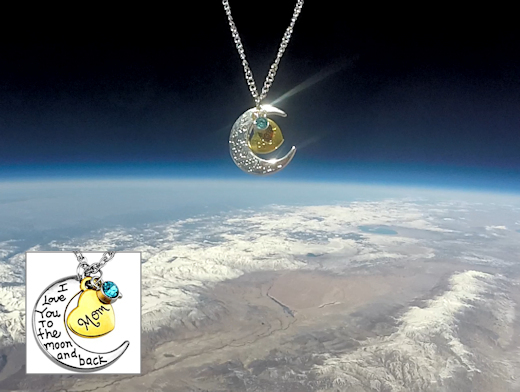
The silvery crescent declares "I love you to the Moon and Back" and surrounds a 14K gold plated heart labeled "Mom."
You can have it for $99.95. The students are selling these pendants to support their cosmic ray ballooning program. Each one comes with a greeting card showing the item in flight and telling the story of its journey to the edge of space. Sales support the Earth to Sky Calculus cosmic ray ballooning program and hands-on STEM research.
Far Out Gifts: Earth to Sky Store
All sales support hands-on STEM education
Realtime Aurora Photo Gallery
Free: Spaceweather.com Newsletter