FREE BALLOON FLIGHTS TO THE STRATOSPHERE: Hey, did your science class get cancelled? Are you stuck at home with nothing to do? Maybe now is the time to visit the stratosphere. We're giving away high-altitude balloon launches to students and citizen scientists who have good ideas for experiments. The program is called FREELIFT, and you're invited to participate.
INTRODUCING COMET SWAN: Warning: This story may give you a sense of déjà vu. A new comet has been discovered, and in late May it will pass by the sun near the orbit of Mercury. No, it's not Comet ATLAS (C/2019 Y4), which is currently falling apart on a similar trajectory. Instead, this is Comet SWAN (C/2020 F8):

Michael Mattiazzo of Swan Hill, Victoria, Australia, took the picture on April 13th. "This is a 5 minute exposure through my 11-inch Celestron telescope," says Mattiazzo. "A visual observation using 15x70mm binoculars gave a magnitude of 8.1."
Mattiazzo discovered the comet two days earlier when he was looking at data from the Solar and Heliospheric Observatory (SOHO). It suddenly appeared in images from SOHO's SWAN instrument. "This is my 8th discovery credit for SWAN comets since 2004 and I do check the data on most days," says Mattiazzo.
Post-discovery images taken by Italian astronomer Ernest Guido and colleagues confirm that the comet is bright (8th magnitude), green, and has a long tail:

"We took this picture on April 11th--the same day Mattiazzo found the comet in SWAN data," says Guido. "We couldn't see it from Italy, so we used a remote-controlled 0.1 meter telescope in Australia."
SOHO's SWAN instrument was not designed to find comets. Its job is to survey the solar system for hydrogen. When the solar wind blows into a cloud of hydrogen-bearing compounds, the impact produces UV photons that SWAN can photograph.
"For SWAN to see a comet, it means the comet must be producing a fairly significant amount of hydrogen," explains Karl Battams of the Naval Research Lab in Washington DC. "This is usually in the form of water-ice."
"It's extremely likely that Comet SWAN is in 'outburst' mode," he continues. "That is, some major eruption happened to this otherwise small and faint comet, releasing a massive cloud of hydrogen-rich volatiles. SWAN is picking up on this sudden dump of hydrogen into the inner solar system."

Click to view an interactive preliminary orbit of Comet SWAN. Credit: Gideon van Buitenen
If the outburst continues, Comet SWAN could become visible to the naked eye next month. Preliminary light curves suggest that it could reach 3rd magnitude--dim, but visible without optics. However, Battams, who correctly predicted the demise of Comet ATLAS, is not so sure.
"I doubt that the comet will maintain its current impressive appearance, and will quite possibly fade away soon," he says. "But we've only been viewing it for a couple of days, so no one knows."
Comet SWAN is currently located in southern skies, best seen by telescopes in Australia, New Zealand, southern Africa and South America. Preliminary orbital elements are available here. Stay tuned for updates.
Realtime Space Weather Photo Gallery
Free: Spaceweather.com Newsletter
A MOTHER'S DAY GIFT FROM THE STRATOSPHERE: Tell Mom how much you love her -- to the Moon and Back! On March 5th, the students of Earth to Sky Calculus launched an array of cosmic ray sensors to the edge of space onboard a helium balloon. This Mother's Day pendant went along for the ride:
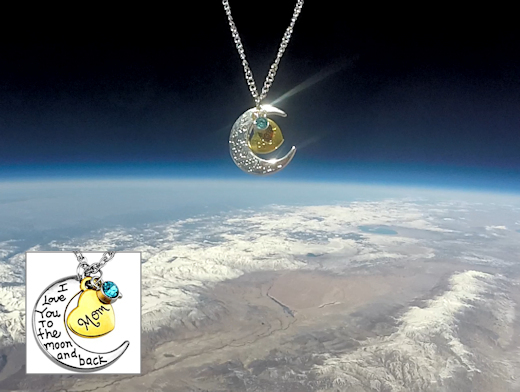
The silvery crescent declares "I love you to the Moon and Back" and surrounds a 14K gold plated heart labeled "Mom."
You can have it for $99.95. The students are selling these pendants to support their cosmic ray ballooning program. Each one comes with a greeting card showing the item in flight and telling the story of its journey to the edge of space. Sales support the Earth to Sky Calculus cosmic ray ballooning program and hands-on STEM research.
Far Out Gifts: Earth to Sky Store
All sales support hands-on STEM education
Realtime Aurora Photo Gallery
Free: Spaceweather.com Newsletter