INTRODUCING COMET SWAN: A bright new comet is approaching the sun. Discovered just a few days ago by the Solar and Heliospheric Observatory (SOHO), Comet SWAN is an easy target for backyard telescopes in the southern hemisphere and it could become a naked eye object in May. FULL STORY.
FRAGMENTS OF COMET ATLAS RACE TOWARD THE SUN: Has Comet ATLAS (C/2019 Y4) undergone mitosis? Amateur astronomers taking a close look at the comet's core are seeing two nearly identical fragments racing toward the sun. Jose De Queiroz and Michael Deyerler send this picture taken April 15th from Switzerland's public Mirasteilas Observatory:

"We used the observatory's 90cm remote-controlled telescope with an SBIG STL-11000 camera," explains Deyerler. "We have been monitoring the comet with this large public telescope since early April." Their images show the beginning of ATLAS's breakup on April 1st, followed by increasing fragmentation on April 11th, 14th, and 15th.


The fragmentation of Comet ATLAS has unfortunately *not* multiplied its brightness. According to the Comet Observation Database, Comet ATLAS has dimmed by 2 magnitudes (a factor of ~6) since the breakup began. The disintegrating nucleus seems to be exhausting its stores of gas and dust very rapidly and, indeed, the comet may not survive much longer. Continued monitoring is encouraged.

Realtime Space Weather Photo Gallery
Free: Spaceweather.com Newsletter
ITALIAN POLLEN CORONA: It begins with a sneeze. Pollen floating through the air tickles your nose, and your body responds by expelling the allergen. Gesundheit! When the paroxysm subsides, look up at the sky. The same pollen that makes you sneeze can also make colorful coronas around the sun, like this one photographed on April 14th by Paolo Bardelli of Sumirago (Varese), Italy:

"Our birch trees are in full bloom," says Bardelli, "A warn dry wind sept out of the north creating a 'perfect storm' of pollen and an excellent chance to spot the elusive pollen corona around the sun. I stood in the narrow shadow of a rooftop weather station to capture this image."
Coronas are rings of light produced by sunlight scattering from the outsides of small particles--in this case, pollens. Tiny droplets of water in clouds can make coronas, too, but pollen grains do even better. They make small but very colorful rings of light.
Unlike water droplets, pollens are non-spherical--and this adds to their magic. Many pollens have air sacs to help carry them in the wind. These align the grains so that their coronas are elliptical. This effect may be seen in Bardelli's corona, which is about 10% taller than it is wide.
"It was fantastic!" says Bardelli. "Although with my allergies, I still haven't stopped sneezing!"
MR. SPOCK COLLECTOR'S ITEM: If you would like to support the Earth to Sky Calculus cosmic ray ballooning program, there's a logical way to do it. Puchase this Mr. Spock collector's item. Here is the green-blooded science officer floating 32.2 km (112,200 ft) above Death Valley National Park in central California:
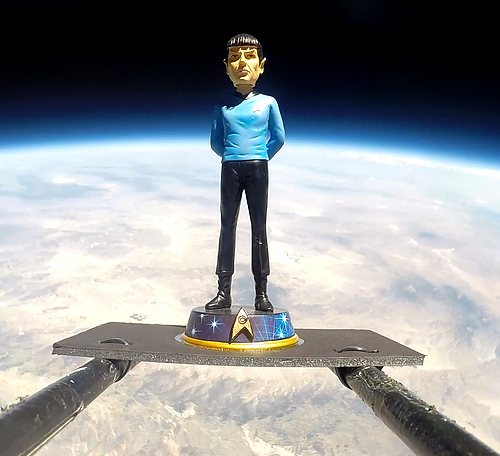
You can have him for $170.10. The price, in case you're wondering, is the serial number of the Enterprise, NCC1701, divided by 10. The students are selling Spock to buy more helium! He comes with a greeting card showing the high-quality resin bobblehead in flight and telling the story of his journey to the stratosphere and back again.
Far Out Gifts: Earth to Sky Store
All sales support hands-on STEM education
Realtime Aurora Photo Gallery
Free: Spaceweather.com Newsletter