LYRID METEOR ALERT: The first significant meteor shower in months is about to begin. The annual Lyrid meteor shower peaks on the night of April 21-22 when Earth passes through a stream of debris from Comet Thatcher (C/1861 G1). These meteors are best seen from the northern hemisphere where the radiant is high in the sky before dawn: sky map.

STARLINK SATELITES PHOTOGRAPHED FROM THE ISS: For the first time, SpaceX's controversial Starlink satellites have been photographed by astronauts onboard the International Space Station. Here they are, photobombing a display of aurora australis on April 13, 2020:
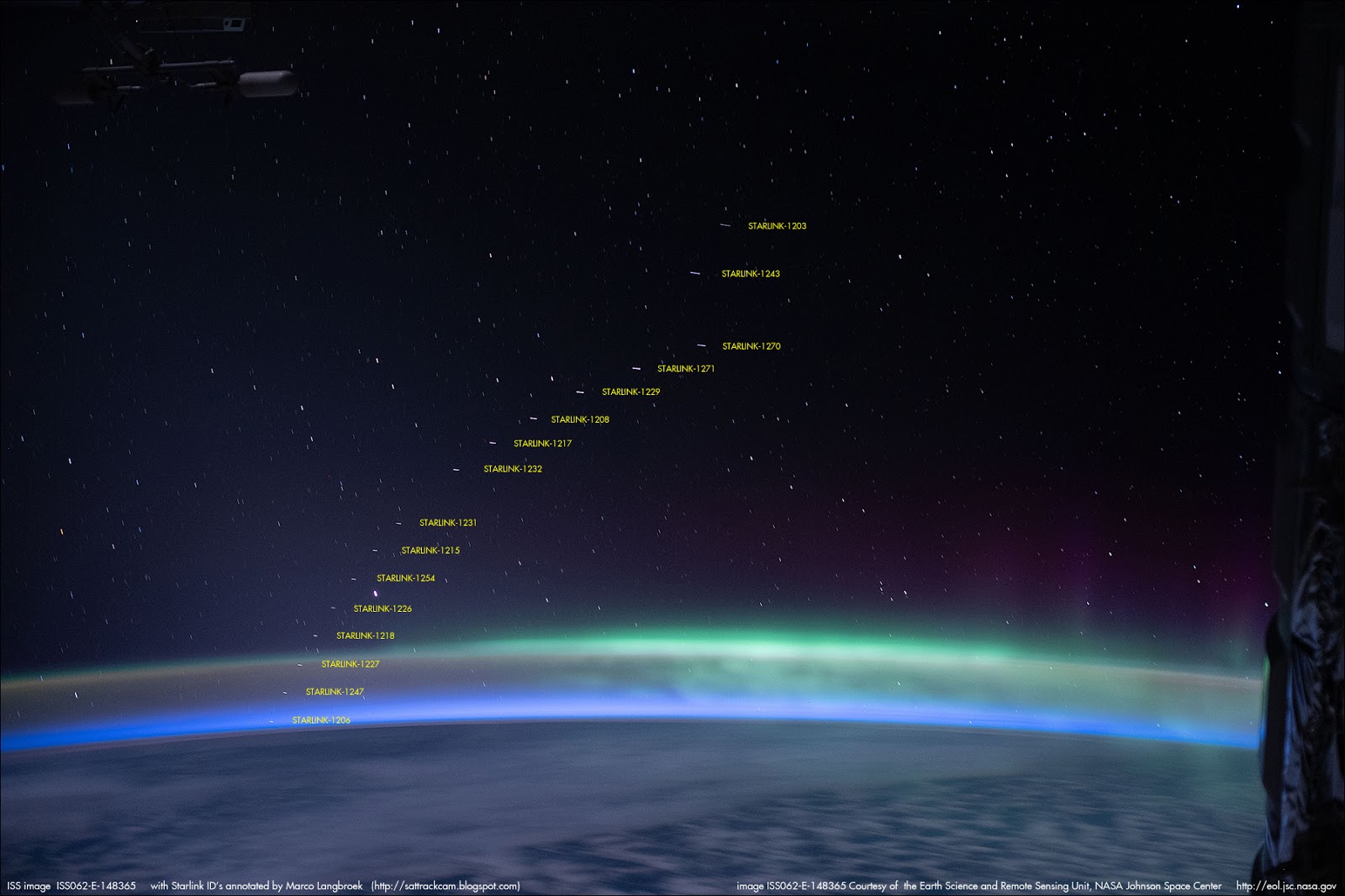
The ISS was flying over the southern Indian Ocean when the sighting occurred with cameras pointing generally south toward Antarctica. At the time, a minor stream of solar wind was buffeting Earth's magnetic field, sparking auroras over the frozen continent. The Starlink train stretches all the way from the twilight-blue horizon to the starry sky high above the aurora layer.
Dutch satellite expert Marco Langbroek identified the Starlink satellites and labeled the original NASA image. "These are all objects from the 17 February 2020 launch--- a.k.a. 'Starlink 4,'" Langbroek wrote in his blog.
Starlink is a new venture by SpaceX, which aims to surround Earth with satellites and beam affordable internet to remote locations all over the world. It is controversial because of its potential effect on the night sky. Just after launch, Starlink satellites easily can be seen with the unaided eye, swarming across stars and planets familiar to backyard astronomers. Scott Tucker of Tucson, Arizona, was photographing Venus on the evening of April 17th when this happened:
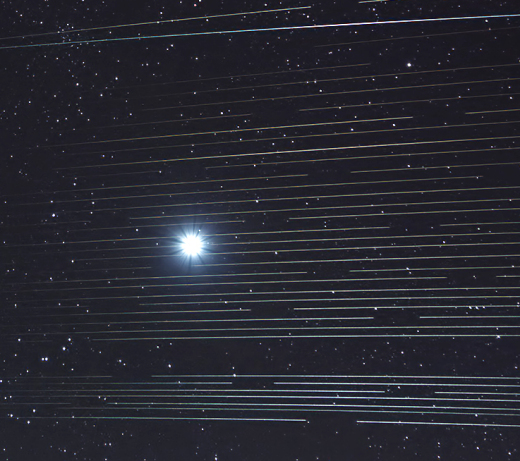
"I watched 41 Starlink satellites from the most recent launch pass by Venus during late twilight," says Tucker. "One of them even flared like an Iridium satellite! It got to magnitude -2 for a few seconds."
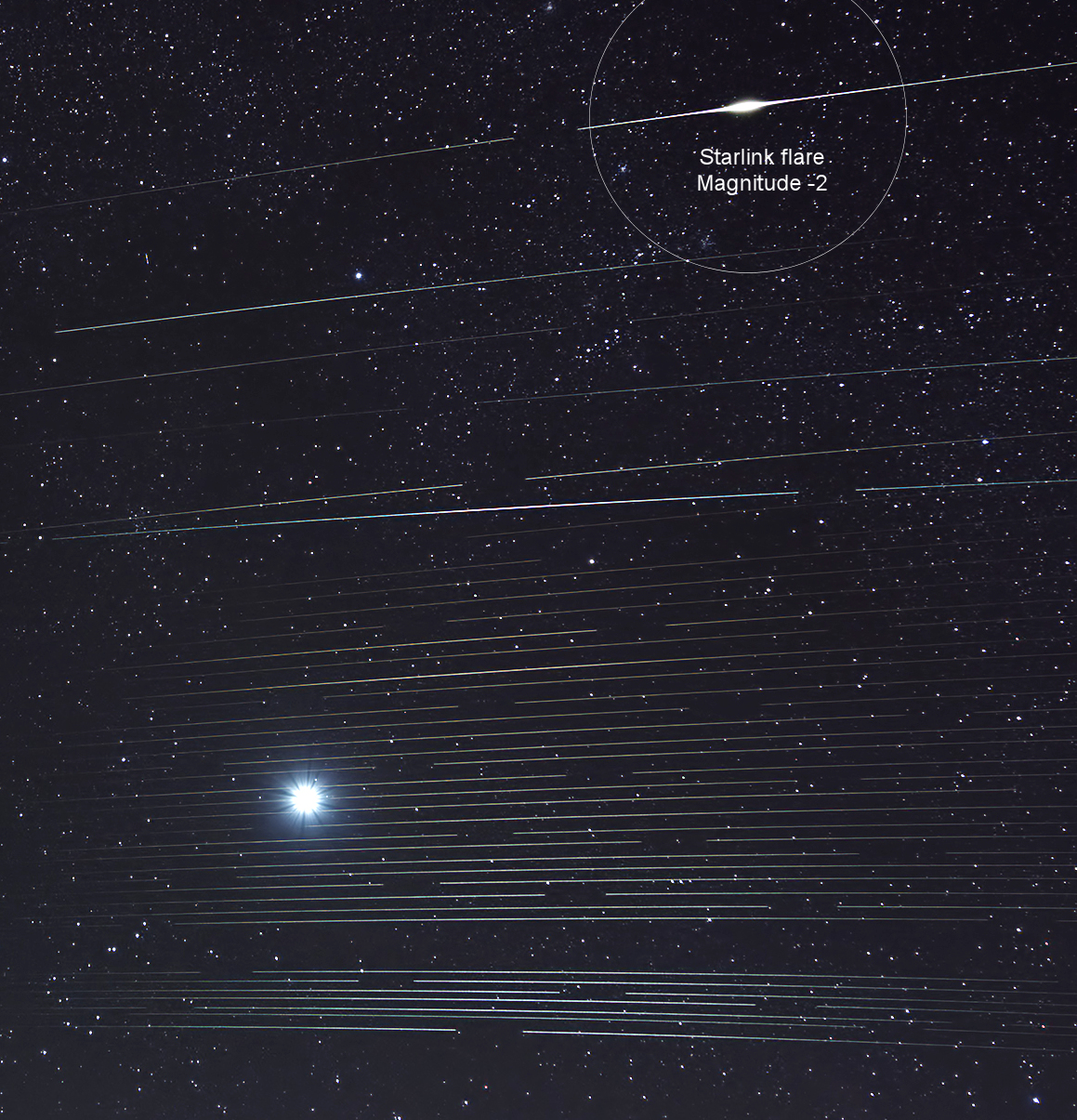
Newly-launched Starlink satellites eventually dim as they approach operational orbits 550 km above Earth--but even then they can interfere with research astronomy. Big telescopes have no trouble detecting Starlink satellites no matter how high they go. The fact that SpaceX plans to launch at least 12,000 of them has prompted the International Astronomical Union to sound the alarm.
So far, there are 360 Starlinks into Earth orbit, a tiny fraction of the ultimate total, yet still a large number. Accidental sightings have become so common that we now have an entire photo gallery of Starlink sightings. Browse the collection and see what you think.
Realtime Starlink Photo Gallery
Free: Spaceweather.com Newsletter
STERLING SILVER "I HEART MOM" SPACE PENDANT: Mother's Day is only a few weeks away. Are you looking for a far-out gift? This 925 sterling silver pendant has been to the edge of space, and you can have it for $139.95.

The students of Earth to Sky Calculus are selling Mother's Day pendants to support their cosmic ray ballooning program. This one traveled 108,596 ft above the snowy Sierra Nevada mountains of central California on April 3, 2020. Each pendant comes with a greeting card showing the necklace in flight and telling the story of its journey to the edge of space.
Far Out Gifts: Earth to Sky Store
All sales support hands-on STEM education
IS COMET SWAN HYPERBOLIC? Newly-discovered Comet SWAN (C/2020 F8) is shaping up to be a beauty. It looks great through small telescopes now, and could become visible to the naked eye next month. Gerald Rhemann sends this picture taken yesterday from Farm Tivoli, Namibia:
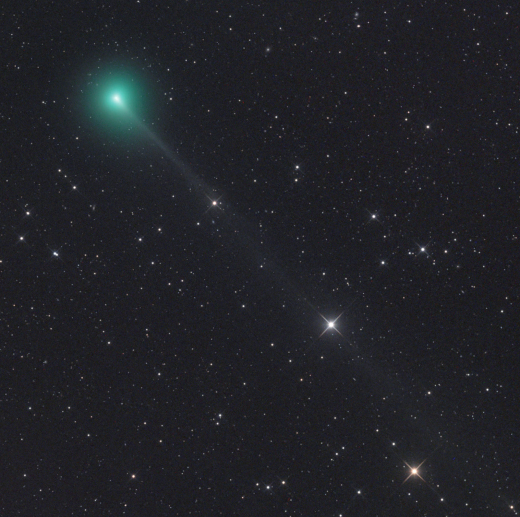
"The comet's tail is almost a full degree long," says Rhemann. "And it was an easy target for my 12-inch telescope at magnitude +7.5."
Where does this beautiful comet come from? SWAN's trajectory is an important clue. It's falling toward the sun for the first time, and the sun's gravity will probably slingshot Comet SWAN back into deep space. Comet SWAN may be a "hyperbolic comet"--that is, a comet whose orbit has an eccentricity greater than 1. Such comets come from the Oort Cloud or may even be interstellar.
The case for Comet SWAN being a hyperbolic comet is not ironclad. Based on an observation arc of only 3 days, JPL reports the eccentricity of SWAN's orbit as 1.1 +/- 0.2. The error bars are still large. The uncertainties will shrink, however, as more observations are added to the database in the nights ahead. Stay tuned for updates.
Realtime Comet Photo Gallery
Free: Spaceweather.com Newsletter
Realtime Aurora Photo Gallery
Free: Spaceweather.com Newsletter
Realtime Space Weather Photo Gallery
Free: Spaceweather.com Newsletter