LYRID METEOR SHOWER: The Lyrid meteor shower is peaking today, April 22nd, as Earth passes through a stream of debris from Comet Thatcher (C/1861 G1). Meteor rates are just below 15 per hour, according to observers with the International Meteor Organization--a relatively minor shower. Despite the low rates, Spaceweather.com readers have several several nice Lyrids: #1, #2, #3, #4, #5.
STARLINK x STARLINK: What's worse than a train of Starlink satellites cutting across an astro-photo? Two trains of Starlink satellites cutting across an astro-photo. In the Czech republic on April 19th, amateur astronomer Zdenek Bardon captured perhaps the first picture of two orthogonal Starlink trains in a single image:

"I was trying to photograph disintegrating Comet ATLAS (C2019 Y4)," says Bardon. "My local night sky suffers from light pollution, and stacking of multiple exposures is necessary in order to image the comet. Unfortunately, I had not considered the trajectories of the Starlink satellites, and many of my exposures were contaminated."
This is the latest illustration of a growing problem. To date, SpaceX has launched 360 Starlink satellites -- with more than 12,000 planned. These satellites are showing up unwelcomed in so many images of the night sky, we now have an entire photo gallery devoted to them.
The whole situation reminds Spaceweather.com reader Peter Tarr (Chief Science Writer at the Brain & Behavior Research Foundation) of classic science fiction. "For those old enough, Bardon's astonishing image of the cross-hatch pattern made by Starlink satellites is the coming-to-life of 'The Tholian Web' of the original Star Trek series."

"Only problem is, it's not the Enterprise that's caught in Elon's Web; it's Earth-based observational astronomy!" he says.
Realtime Starlink Photo Gallery
Free: Spaceweather.com Newsletter
STERLING SILVER SPACE PENDANT: Mother's Day is only weeks away. Are you looking for a far-out gift? This 925 sterling silver pendant has been to the edge of space, and you can have it for $139.95.
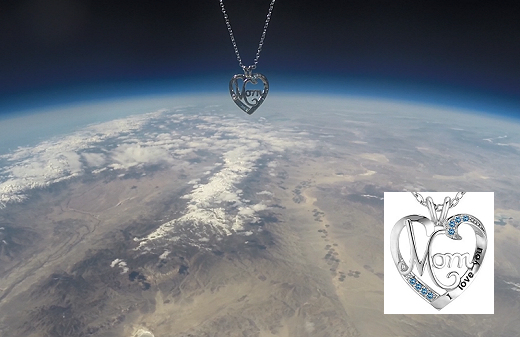
The students of Earth to Sky Calculus are selling Mother's Day pendants to support their cosmic ray ballooning program. This one traveled 108,596 ft above the snowy Sierra Nevada mountains of central California on April 3, 2020. Each pendant comes with a greeting card showing the necklace in flight and telling the story of its journey to the edge of space.
Far Out Gifts: Earth to Sky Store
All sales support hands-on STEM education
THE AFTERGLOW OF A CME: Last night, John Gray of North Dell on Scotland's Isle of Lewis went outside to look for Lyrid meteors. "Look what popped up instead," he says. Gray caught the afterglow of a CME:

"The display started just after midnight and lasted for about 30 minutes," he says. "It made for a nice change!"
Two days ago, a slow-moving CME (coronal mass ejection) hit Earth's magnetic field, sparking the first geomagnetic storm of 2020. The storm has subsided, but intermittent auroras continue as our planet moves through the CME's wake. A minor solar wind stream due on April 22nd will boost the odds of additional high latitude auroras through April 23rd. Aurora alerts: SMS Text.
Realtime Aurora Photo Gallery
Free: Spaceweather.com Newsletter
Realtime Space Weather Photo Gallery
Free: Spaceweather.com Newsletter