SOLAR MINIMUM CONDITIONS ARE IN EFFECT: The sun has been blank (without sunspots) for 18 consecutive days. This is a sign that Solar Minimum is underway. The sun is passing through the nadir of the 11-year solar cycle, a slow process that could continue for much of 2020. Stay tuned for quiet. Aurora alerts: SMS Text.
SPRITE SEASON HAS BEGUN: A series of unusually severe spring storms parading across the southeastern USA has residents taking shelter from golf-ball sized hail and dangerous tornadoes. High above the maelstrom, sprites are dancing. Paul M. Smith of Edmond, Oklahoma, captured these specimens on April 22nd.

"There were tornado warnings and very large hail throughout the night," says Smith. "I photographed the sprites through a clearing around midnight."
Sprites are a form of electricity in powerful storm clouds. While regular lightning lances down, sprites leap up. They can reach all the way to the edge of space 90 km or more above Earth's surface. Spring thunderstorms often produce the year's first big sprites, and the sightings continue through late summer.
"My camera was pointed toward Oklahoma City," says Smith, "and the sprites were about 150 miles away." This radar weather map shows shows the observing geometry:
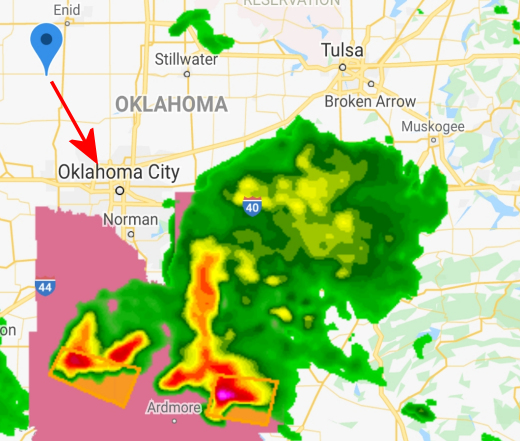
When observing sprites, this kind of distance is a good thing. It allows a camera to see over the top of the thunderhead into the sprite zone. It also provides a measure of safety, separating the photographer from lightning strikes.

Smith also photographed sprites on Easter Sunday. They towered over a storm in Arkansas that made headlines for its ferocity and destructiveness. "The sprites were so bright, I was able to photograph them in almost-full moonlight," he says.
This could turn into one of the best sprite seasons on record. Why? Solar Minimum. The sun is currently experiencing one of the deepest minima in 100 years. As the sun's magnetic field weakens, more cosmic rays from deep space are reaching Earth. Some researchers believe that cosmic rays help sprites get started by creating conductive paths in the atmosphere. Intensifying cosmic rays could produce an unusually spriteful spring.
Are you ready?
Realtime Sprite Photo Gallery
Free: Spaceweather.com Newsletter
STERLING SILVER SPACE PENDANT: Mother's Day is only weeks away. Are you looking for a far-out gift? This 925 sterling silver pendant has been to the edge of space, and you can have it for $139.95.

The students of Earth to Sky Calculus are selling Mother's Day pendants to support their cosmic ray ballooning program. This one traveled 108,596 ft above the snowy Sierra Nevada mountains of central California on April 3, 2020. Each pendant comes with a greeting card showing the necklace in flight and telling the story of its journey to the edge of space.
Far Out Gifts: Earth to Sky Store
All sales support hands-on STEM education
AN EXPLODING LYRID METEOR: The annual Lyrid meteor shower peaked on April 22nd when Earth passed through a stream of debris from Comet Thatcher (C/1861 G1). Worldwide observers counted as many as 20 meteors per hour. One of them exploded over Sedona, Arizona:

Robert Mueller photographed the explosion and kept his camera clicking while the smoky debris twisted in the wind 80 km above Earth. "The swirling gases were visible for nearly 20 minutes," Mueller says.
This smoky debris could reappear next month in the form of a noctilucent cloud (NLC). Noctilucent clouds form when summertime water vapor rises to the edge of space and crystallizes around specks of meteor smoke. The northern season for NLCs starts in mid-May. Stay tuned for electric blue.
Realtime Space Weather Photo Gallery
Free: Spaceweather.com Newsletter
Realtime Aurora Photo Gallery
Free: Spaceweather.com Newsletter