ANOTHER NEW-CYCLE SUNSPOT: In a continuing show of strength from Solar Cycle 25, another new-cycle sunspot appeared on the sun today. Provisionally numbered "AR2762," it is located at high latitude in the sun's northern hemisphere. Amateur astronomers with safely-filtered solar telecopes are encouraged to monitor developments. Browse: Photo Gallery.

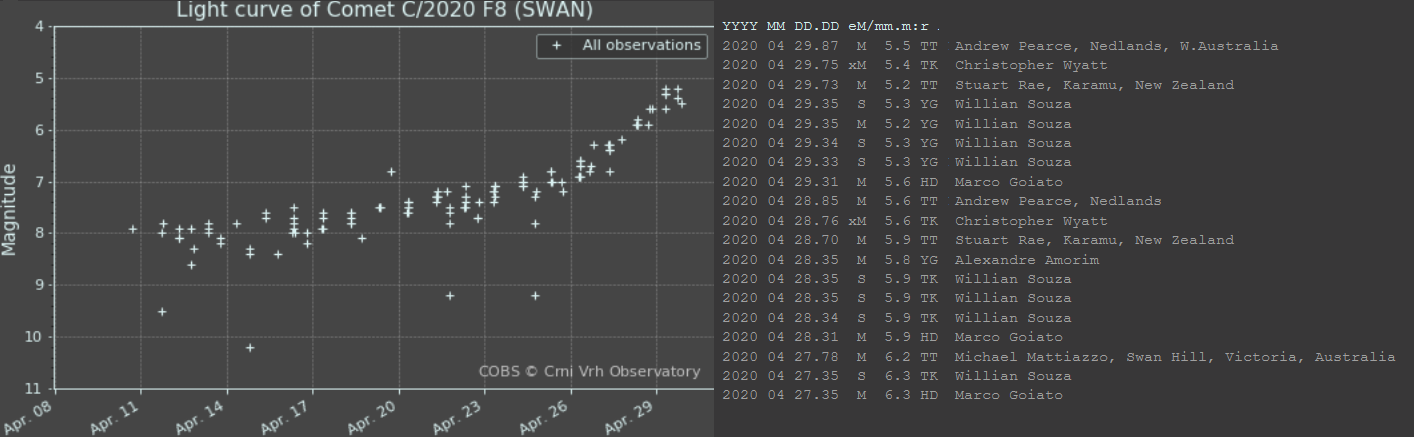
COMET SWAN UPDATE: Comet SWAN (C/2020 F8) is brightning rapidly. "I just came in from observing it with the naked eye," reports John Drummond of Gisborne, New Zealand. "It seems to have increased in brightness dramatically since I last observed it a few nights ago." Indeed, multiple observers have now pegged the comet at magnitude +5.5, just within the range of human visibility.
At the moment, naked eyes can see the comet only as a dim fuzzball, but even small telescopes reveal much more. Gerald Rhemann sends this picture from Farm Tivoli, Namibia:

"This is a 30 minute exposure through my 12-inch Astrograph," says Rhemann, who also made a magnificent animation of the comet. In only about 40 minutes of tracking, it is possible to see complicated waves and tendrils of gas rippling down the comet's tail. A deep exposure made by John Drummond highlights jets emerging from the comet's core.
The comet's tail is so long, Rheman could not fit it in the field of view. "The tail in my photo is 1.2 degrees long," he says. "I know from friends who have photographed wider fields that it actually stretches about 8 degrees across the sky." For comparison, the bowl of the Big Dipper is 10 degrees wide.

Above: The light curve of Comet SWAN courtesy of the Comet Observation Database (COBS).
Much about Comet SWAN remains unknown. It was discovered just a few weeks ago, on April 11th, when a sudden hydrogen dump by the comet made it show up in data from the Solar and Heliospheric Observatory's SWAN instrument.
"The comet sort of appeared out of nowhere," says Karl Battams of the Naval Research Lab in Washington DC. "What made it flare up? I worry that something unpleasant happened to it, and now it's releasing (possibly exhausting) all of its fresh volatiles."
If so, it could fizzle or even fall apart like its cousin Comet ATLAS recently did. However, says Battams, "Comet SWAN seems to be holding together better than Comet ATLAS, so there's hope!"
Comet SWAN's hyperbolic orbit suggests that it might be a first-time visitor to the inner solar system. Such newcomers are notoriously unpredictable, and no one can say for sure what will happen next, so stay tuned.
Realtime Space Weather Photo Gallery
Free: Spaceweather.com Newsletter
MOTHER'S DAY IS LESS THAN TWO WEEKS AWAY! Are you looking for an out-of-this world Mother's Day gift? Consider this: Every time the students of Earth to Sky Calculus launch a cosmic ray balloon, they include something extra in the payload--something Mom will love:

Every item in the Earth to Sky Store has flown to the edge of space and comes with a greeting card showing the item in flight. The interior of the card tells the story of the gift's journey from launch to landing. Mom-satisfaction guaranteed!
Far Out Gifts: Earth to Sky Store
All sales support hands-on STEM education
Realtime Aurora Photo Gallery
Free: Spaceweather.com Newsletter