REFLECTED TSUNAMIS AND SPACE WEATHER: When the Earth trembles, even the edge of space moves. Researchers have known for decades that earthquakes and tsunamis send waves of air pressure to the very top of Earth’s atmosphere. Up there, in the ionosphere, the waves scramble GPS signals and interfere with radio communications much like solar flares do. Earthquakes, it turns out, can mimic space weather.
A new paper published in the research journal Space Weather shows that earthquakes and tsunamis may, in fact, affect the ionosphere much more than previously thought.
"On 11 March 2011, a magnitude 9.0 earthquake occurred near the east coast of Honshu, Japan, unleashing a savage tsunami as well as unprecedented ripples at the space‐atmosphere interaction region," report the authors, led by Min-Yang Chou of the University Corporation for Atmospheric Research (UCAR) in Boulder, CO.
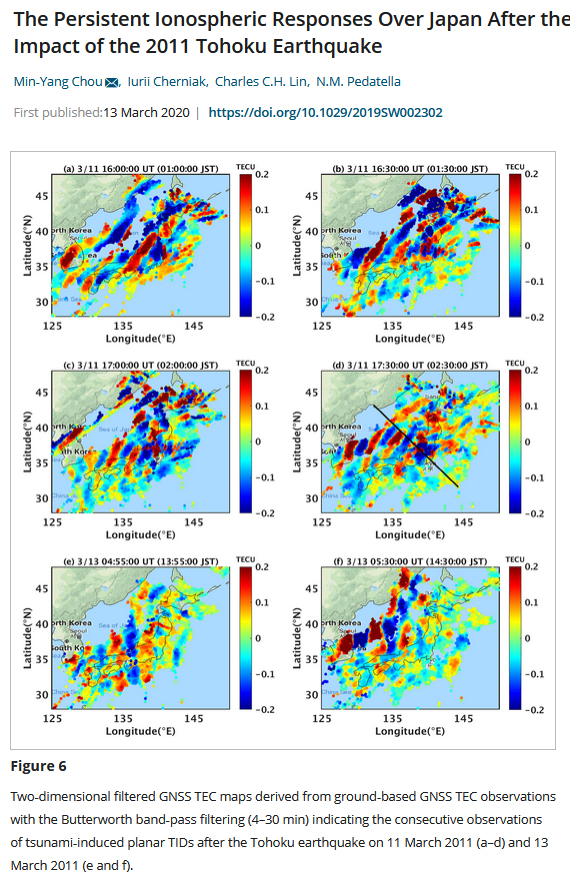
Above: Ionospheric disturbances over Japan on March 11, 2011. Full Caption
Using satellites and ground-based GPS receivers, Chou and colleagues took a close look at what happened to the ionosphere over Japan in the aftermath of the earthquake. As expected, it was disturbed. Surprisingly, though, the ionospheric disturbances didn’t peter out after the initial quake and tsunami; they kept going for many more hours.
The reason: Reflected tsunamis.
"The tsunami was reflected by multiple sources such as seamounts, islands and ridges," says Chou. "These reflections created multiple concentric tsunami wave patterns in the ocean." Bouncing back and forth across the Pacific, reflected tsunamis kept the ionosphere above Japan disturbed for as much as 46 hours.
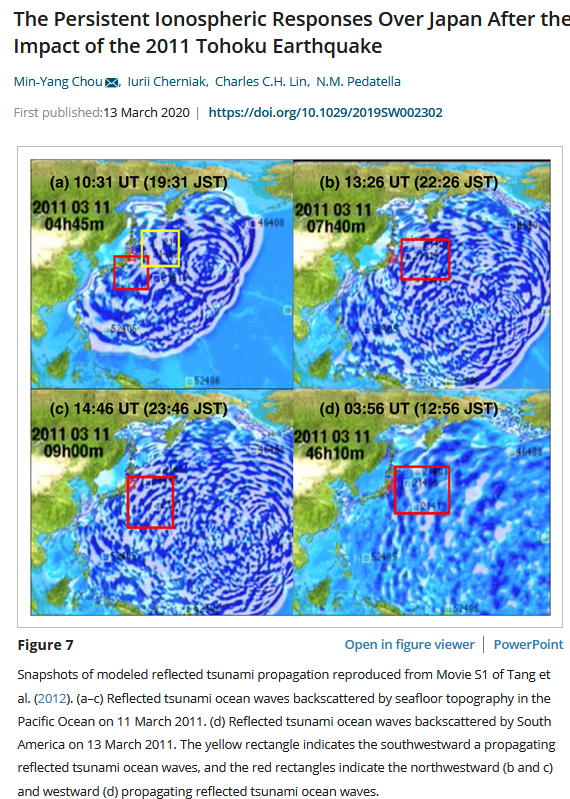
Above: Tsunami waves reflected from sea floor topography on March 11-13, 2011. Full caption.
Researchers once thought that only the sun could disturb the ionosphere so much. Solar flares bathe the top of our atmosphere with ultraviolet and X-radiation, sending waves of ionization rippling through the ionosphere. Sound familiar? Earthquakes and tsunamis have the same effect. In fact, Chou says, the disturbances over Japan were akin to a series of strong X-class solar flares.
In some ways, tsunamis are even worse. The disturbances they produce last for days and, because of reflections, can be very complicated. Reflected waves near Japan in 2011 caused chaotic nighttime "twinkling" of GPS satellite signals–enough to cause some GPS devices to completely lose lock.
As 2020 unfolds, the sun is experiencing one of the deepest Solar Minima of the past century. There are no solar flares. At a time like this, earthquakes and tsunamis rule, mimicking stormy space weather in the absence of the real thing.
Now more than ever, "understanding how natural hazards [such as tsunamis] impact our upper atmosphere and cause variations in the space environment around Earth is crucial," says Chou.
A sharable version of this story is available here.
Realtime Space Weather Photo Gallery
Free: Spaceweather.com Newsletter
MOTHER'S DAY IS LESS THAN TWO WEEKS AWAY! Are you looking for an out-of-this world Mother's Day gift? Consider this: Every time the students of Earth to Sky Calculus launch a cosmic ray balloon, they include something extra in the payload--something Mom will love:
Every item in the Earth to Sky Store has flown to the edge of space and comes with a greeting card showing the item in flight. The interior of the card tells the story of the gift's journey from launch to landing. Mom-satisfaction guaranteed!
Far Out Gifts: Earth to Sky Store
All sales support hands-on STEM education
Realtime Aurora Photo Gallery
Free: Spaceweather.com Newsletter