ETA AQUARID METEOR UPDATE: The eta Aquarid meteor shower, caused by dust from Halley's Comet, is still active on May 6th, but it appears to be subsiding. Data from the International Meteor Organization suggest that the shower peaked on May 4th with maximum rates near 45 per hour. Glare from the waxing full Moon will make the display difficult to see for the next few nights. Practically speaking, for casual sky watchers the show is over.
WHAT JUST HAPPENED TO COMET SWAN? This week, an unexpected outburst from Comet SWAN (C/2020 F8) amazed observers in the southern hemisphere, who could actually see the comet brighten with their unaided eyes.
What happened? It might have fragmented, exposing bright clouds of dusty gas to the sun. Certainly the comet's tail looks like debris from an explosion:

Above: Comet SWAN photographed by Gerald Rhemann of Farm Tivoli, Namibia on May 1st. [more]
But Karl Battams of the Naval Research Lab in Washington, DC, doesn’t think so. "Outbursts do not necessarily imply fragmentation, and ground-based images are not yet showing evidence of a breakup," he says. "This could just be a particularly feisty and volatile comet."
Comet SWAN was discovered on April 11th when Australian amateur astronomer Michael Mattiazzo noticed a curious "bloom" in images from SOHO's SWAN camera. SWAN surveys the solar system for hydrogen gas, and it caught the comet making a sudden hydrogen dump. That might have been Comet SWAN’s first outburst.
A second outburst starting in late April turned SWAN into a naked eye object:

Fresh comets often behave this way–cracking, fracturing, and exposing veins of volatile material as they approach the sun for the first time. Comet SWAN is just such an object. It has a hyperbolic orbit, which suggests it has never been here before. Sunlight is touching its surface for the first time with unpredictable results.
More outbursts could be in the offing. Dates of special interest include May 12th when the comet passes by Earth (0.56 AU) and May 27th when the comet slingshots past the sun not far from the orbit of Mercury (0.43 AU). Observers in the southern hemisphere will have a front row seat for whatever happens.
"It would not surprise me at all to see another outburst – maybe several – in the coming weeks as it closes in on the sun later this month," says Battams.
Stay tuned!
A sharable version of this story with observing tips is available here.
Realtime Comet SWAN Photo Gallery
Free: Spaceweather.com Newsletter
MR. SPOCK IN THE STRATOSPHERE: If you would like to support the Earth to Sky Calculus cosmic ray ballooning program, there's a logical way to do it. Puchase this Mr. Spock collector's item. Here is the green-blooded science officer floating 32.2 km (112,200 ft) above Death Valley National Park in central California:
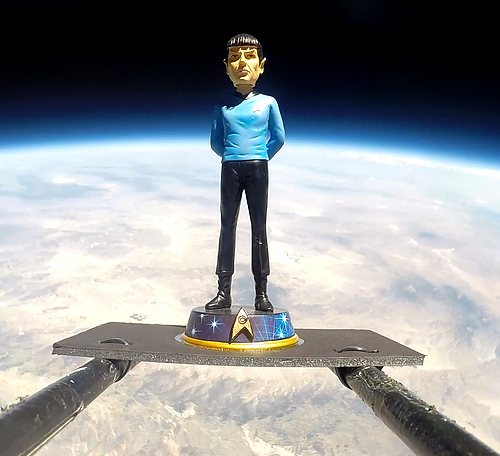
You can have him for $170.10. The price, in case you're wondering, is the serial number of the Enterprise, NCC1701, divided by 10. The students are selling Spock to buy more helium! He comes with a greeting card showing the high-quality resin bobblehead in flight and telling the story of his journey to the stratosphere and back again.
Far Out Gifts: Earth to Sky Store
All sales support hands-on STEM education
Realtime Aurora Photo Gallery
Free: Spaceweather.com Newsletter
Realtime Space Weather Photo Gallery
Free: Spaceweather.com Newsletter