ANOTHER OUTBURST FOR COMET SWAN? Comet SWAN (C/2020 F8) just finished one naked-eye outburst. Another might be underway. Magnitude estimates from observers in the southern hemisphere suggest that Comet SWAN's brightness is rebounding: light curve. This development comes as the comet approaches Earth for a 0.56 AU flyby on May 12th. Stay tuned.

THE TRANSFORMATION OF VENUS: On June 3rd, Venus will pass almost directly between Earth and the sun--an event astronomers call "inferior solar conjunction." Between now and then, Venus will turn its night side toward Earth, turning the planet into an increasingly slender crescent. Astrophotographer Raffaello Lena of Rome, Italy, has been monitoring the transformation:

"The progression of the crescent as Venus approaches inferior conjunction is clear," says Lena. "I took these pictures using an 18 cm (7 inch) Mak Cassegrain telescope."
You don't need a telescope to see the shape of Venus. Even ordinary binoculars will show the crescent. Just point your optics at the super-bright "Evening Star" in the western sky after sunset. This animation created by Larry Koehn of ShadowandSubstance.com shows where to look:
By the end of May, Venus will become a breathtakingly thin crescent, fringed with rainbow colors by refraction in the low twilight atmosphere. The horns of the crescent might actually touch when the Venus-sun angle is least on June 3rd--an amazing sight that requires some care to observe.

For the next few weeks, Venus will be must-see viewing in the evening sky. Take a look and submit your images here.
Realtime Space Weather Photo Gallery
Free: Spaceweather.com Newsletter
A SUPER FULL MOON: So you thought all full Moons are the same? Baa-loney. Last night's full Moon was clearly a supermoon. Jan Koeman photographed it from Kloetinge, the Netherlands:

"Our neighbor the Moon was quite close last night, so I cycled around our village to make some photos," says Koeman.
The technical term for this is "perigee Moon." The Moon's orbit is an ellipse with one side (perigee) about 50,000 km closer than the other (apogee): diagram. When the Moon becomes full near perigee, as happened last night, it looks super. Perigee full moons are not unusual; this is the third month in a row we've had one.

Realtime Full Moon Photo Gallery
Free: Spaceweather.com Newsletter
CRYSTAL MOON BALL IN THE STRATOSPHERE: On Star Wars Day ("May the 4th be with you"), the students of Earth to Sky Calculus launched an array of cosmic ray sensors to the stratosphere. They do this every week or so to monitor increasing levels of atmospheric radiation. This crystal Moon ball went along for the ride:
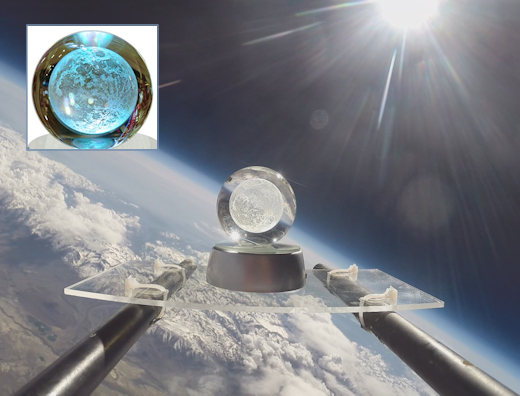
You can have it for $129.95. The students are selling these far-out balls to support their cosmic ray ballooning program.
Each one comes with an LED base that turns the laser-etched crystaline Moon a beautiful shade of purple, blue, green or yellow. It makes a great night light. Also included is a greeting card showing the crystal ball in flight and telling the story of its journey to the edge of space and back again.
Far Out Gifts: Earth to Sky Store
All sales support hands-on STEM education
Realtime Aurora Photo Gallery
Free: Spaceweather.com Newsletter