SOLAR SECTOR BOUNDARY CROSSING: Earth is about to cross a fold in the heliospheric current sheet--a vast wavy structure in interplanetary space separating regions of opposite magnetic polarity. The crossing, called a "solar sector boundary crossing," is expected on May 11th and could trigger geomagnetic activity around Earth's poles. Aurora alerts: SMS Text.
COMET SWAN VS THE SOLAR WIND: A struggle is underway in interplanetary space. The contestants are Comet SWAN (C/2020 F8) vs. the solar wind. The comet has an extremely long tail--wider then 20 full Moons--and this gives it lots of exposure to the solar wind. The result is evident in this extraordinary image from Gerald Rhemann of Farm Tivoli, Namibia:

"I took the picture on May 4th using my 12-inch telescope," says Rhemann. "The tail was so long I had to stitch together 6 panels--and even then I could not capture the whole thing."
Comet SWAN's tail is beautiful -- and a mess, interrupted by many gaps, knots, and billowing clouds. The solar wind is to blame. Irregularities in the solar wind impress themselves onto Comet SWAN, creating the structures in Rhemann's image. The comet is, essentially, a wind sock.
There are even signs of a possible magnetic storm. Magnetic storms in comet tails have been observed before--most famously in 2007 when NASA's STEREO spacecraft watched a CME crash into Comet Encke. Encke's tail was ripped into forms like this dramatic kink in the tail of Comet SWAN:

How could this happen? Magnetic fields around the comet bumped into oppositely directed magnetic fields in the solar wind. Suddenly, these fields linked together--they "reconnected"--releasing a burst of energy that disrupted the comet's tail.
Clearly, Comet SWAN is worth watching. For observing tips, check Bob King's article from Sky & Telescope.
Realtime Space Weather Photo Gallery
Free: Spaceweather.com Newsletter
CRYSTAL MOON BALL IN THE STRATOSPHERE: On Star Wars Day ("May the 4th be with you"), the students of Earth to Sky Calculus launched an array of cosmic ray sensors to the stratosphere. They do this every week or so to monitor increasing levels of atmospheric radiation. This crystal Moon ball went along for the ride:
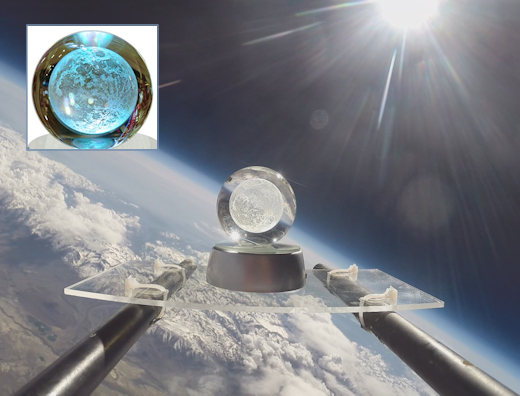
You can have it for $129.95. The students are selling these far-out balls to support their cosmic ray ballooning program.
Each one comes with an LED base that turns the laser-etched crystaline Moon a beautiful shade of purple, blue, green or yellow. It makes a great night light. Also included is a greeting card showing the crystal ball in flight and telling the story of its journey to the edge of space and back again.
Far Out Gifts: Earth to Sky Store
All sales support hands-on STEM education
Realtime Aurora Photo Gallery
Free: Spaceweather.com Newsletter