THE GREAT GEOMAGNETIC STORM OF 1921: 99 years ago this week, the biggest solar storm of the 20th century struck Earth. It set fire to buildings, burnt out telephone lines, and sparked auroras as far south as Tonga and Samoa. New research suggests that the Great Geomagnetic Storm of May 1921 may have been even stronger than previously thought. FULL STORY.
THE COMET THAT REFUSES TO DIE: Earlier this year, sky watchers were excitedly circling May 31st on their calendars. Comet ATLAS (C/2019 Y4) was plunging toward the sun and many thought it might shine as brightly as Venus when it flew inside the orbit of Mercury at the month.
Spoiler alert: That didn't happen. Instead, the comet fell apart. Scorched by intensifying solar heat, ATLAS's icy core prematurely disintegrated in late March. Ground based observers found at least four fragments and the Hubble Space Telescope counted dozens more.
Now the story takes an unexpected turn. Comet ATLAS refuses to die:

Michael Jäger of Jauerling, Austria, took the picture on May 12th. "This is a deep 1500/1500/500 second RGB exposure using my 11-inch telescope," he explains.
No, Comet ATLAS is not as bright as Venus--in fact, it's about 160,000 times dimmer--but it's still a beautiful comet. Fragments inside the comet's core are adding their individual exhaust to ATLAS's green atmosphere, creating a fuzzball about as bright as a 9th magnitude star.
Soon, ATLAS will be too close to the sun for easy viewing from Earth. Fortunately, the Heliospheric Imager on NASA's STEREO spacecraft will get a great view of ATLAS from mid-May through early June. The camera is very sensitive, so it might be able to observe ATLAS interacting with the solar wind–as well as any additional breakup events. Stay tuned!
Realtime Space Weather Photo Gallery
Free: Spaceweather.com Newsletter
THE INFINITY PENDANT: Are you looking for a far-out gift? Nothing says "I Love You" like an Infinity Pendant from the edge of space. On Jan. 8, 2020, the students of Earth to Sky Calculus launched a cosmic ray balloon. This authentic Swarovski crystal pendant hitched a ride, traveling 113,209 feet above the Sierra Nevada mountains of central California
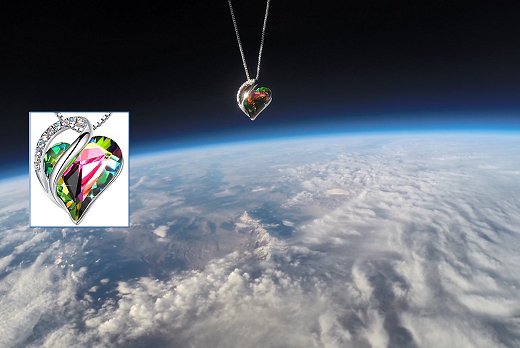
You can have it for $179.95. The students are selling these pendants to support their cosmic ray ballooning program. The glittering heart-shaped crystal is wrapped in a silver-embossed infinity clasp, symbolizing unending love. Each one comes with a romantic card showing the pendant in flight and telling the story of its journey to the edge of space and back again.
Far Out Gifts: Earth to Sky Store
All sales support hands-on STEM education
Realtime Aurora Photo Gallery
Free: Spaceweather.com Newsletter