EDITOR'S NOTE: Today, Dr. Tony Phillips is on a 26 mile hike through Death Valley to recover the payload of a wayward cosmic ray balloon. As a result, some updates to Spaceweather.com may be delayed until May 17th. The data will be worth the wait!
A SUNSPOT IN THE OFFING: A magnetic active region is about to rotate into view over the sun's northeastern limb. Based on its high latitude, it is probably a sunspot from new Solar Cycle 25. Astronomers with solar telescopes should point their safely-filtered optics here. Aurora alerts: SMS Text.
RED AND GREEN RIPPLES IN THE SKY: An astronomer at the McDonald Observatory has discovered a planet with fantastic red and green ripples in its atmosphere. It looks a lot like Texas.
Stephen Hummel was walking across the famous University of Texas observatory grounds a couple hours after sunset on May 13th when he noticed the flash of lightning from a distant thunderstorm. "I saw a large column of sprites leaping into the sky and rushed to set up my camera," he says. Aiming southeast towards the city of Alpine, he recorded this movie:
The video shows alternating bands of red and green airglow gliding overhead like ripples in a giant pool of water. At the same time, red bolts of upward directed lightning (sprites) flashed so brightly "I could see them with my unaided eye," he says. "It was a fantastic display."
Filming the sky in rural southwest Texas can be a little risky. Hummel explains: "I had just hiked to the top of a ridge for a better view, and was a little out of breath as I set up my camera. Just then I heard the eerie sound of a mountain lion's call. I left the camera running while I returned to the safety indoors! Later, I gathered the footage, hoping for the best. I was amazed by the results and surprised the airglow was so evident."
Both the sprites and the ripples originated in a towering thunderstorm about 180 miles away. This weather radar map shows Hummel's location (starred) and the instigating storm system:

The thunderstorm was strongly convective with powerful updrafts. Essentially, it pounded the upper atmosphere from below, creating a bulls-eye pattern of pressure waves in the mesosphere more than 80 km above the ground. This pattern impressed itself upon the airglow layer near the edge of space, amplifying aurora-like colors which are usually too faint to see.
It's no coincidence that Hummel saw sprites at the same time. Mesoscale convective storm systems produce a lot of upward directed lightning. Indeed, sprite hunters often train their cameras above the cloudtops of such systems to get the best shots. Strong updrafts are key ingredients of both phenomena.

More sprites and atmospheric bullseyes are in the offing. Northern spring is thunderstorm season and a great time to catch these events. Are you ready?
Realtime Space Weather Photo Gallery
Free: Spaceweather.com Newsletter
THE POLAR STRATOSPHERIC CLOUD PENDANT: The most beautiful clouds on Earth are located in the stratosphere: Polar Stratospheric Clouds or PSCs. Their extraordinary colors inspired this authentic Swarovski pendant, which has actually been to the stratosphere. Last November it hitched a ride 109,580 feet high on board an Earth to Sky Calculus cosmic ray balloon:
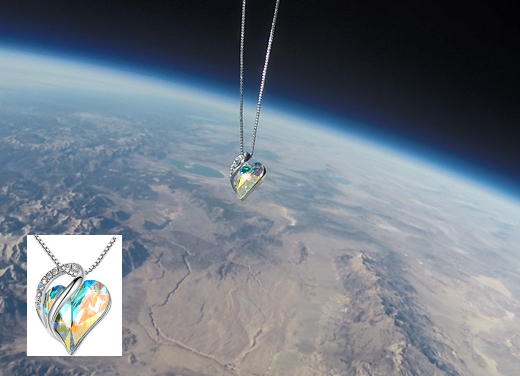
You can have it for $179.95. The students are selling Stratospheric Cloud Pendants to support their cosmic ray ballooning program. Each heart-shaped pendant comes with a card showing it floating through the stratosphere like a real cloud, and telling the story of its journey to the edge of space and back again.
Far Out Gifts: Earth to Sky Store
All sales support hands-on STEM education
Realtime Aurora Photo Gallery
Free: Spaceweather.com Newsletter