SUNSET SKY SHOW--VENUS, MERCURY AND THE MOON: When the sun goes down tonight, step outside and look west. See Venus? She's about to have company. Mercury is approaching for a 1o conjunction on May 21st and 22nd. The planets will be so close together, you can hide them behind a fingertip held at arm's length. Then, on May 23rd and 24th the crescent Moon joins the show. It's a great way to end the day. Sky maps: May 20, 21, 22, 23, 24.


INFERIOR CONJUNCTION OF VENUS: On June 3rd, Venus will pass almost directly between Earth and the sun--an event astronomers call "inferior conjunction." This is changing the face of Venus in an extraordinary way. The planet has become an slender crescent, growing thinner every night. Dave Eagle sends these pictures from Raunds, United Kingdom:

"Watching Venus grow in size and the crescent get steadily thinner has been amazing over the past few weeks," says Eagle. "It will change even quicker now as it approaches inferior conjunction."
Venus is "slenderizing" because it is turning its night side toward Earth. As Venus approaches the sun, only an increasingly narrow sliver of Venus's dayside is visible. It's like a miniature version of the crescent Moon.
Amateur astronomers are encouraged to monitor Venus in the lead-up to inferior conjunction. Only a little magnification is required to see the crescent; binoculars or a small telescope will do the trick. In the nights ahead, the planet's shape will become increasingly thin and circular. The horns of the crescent might actually touch when the Venus-sun angle is least on June 3rd. Stay tuned!
Realtime Space Weather Photo Gallery
Free: Spaceweather.com Newsletter
WHEN LIGHTNING STRIKES A RAINBOW: Raindrops are marvelous things. And if you think all they do is make you wet, think again. Yesterday in Atwater, California, Richard Sears captured two beautiful manifestations of rain in a single shot--a rainbow and lightning:

"A rapidly developing thundercell announced itself with a wild thunderstorm," says Sears. "Just as the setting sun broke through the clouds in the west, a rainbow appeared and a lightning bolt passed through it."
Peaceful rainbows and violent lightning may seem like unlikely relatives, but they do have a common origin. Raindrops make rainbows by reflecting sunlight, breaking the beams of light into their constituent RGB colors. Raindrops also make lightning. Frozen droplets in convective thunderclouds bump and rub together, creating electric charges akin to woolen socks rubbing against carpet. When the charge builds up enough--crack! A white-hot bolt lances across the sky.
"I was lucky to catch them both," says Sears. "What a spectacular show!"
Realtime Space Weather Photo Gallery
Free: Spaceweather.com Newsletter
A BLACK PEARL IN THE STRATOSPHERE: It came from Tahiti--and now it's been to the edge of space. On Feb. 27, 2020, this genuine Black Tahitian South Sea Cultured Pearl flew to the stratosphere onboard an Earth to Sky Calculus cosmic ray balloon, soaring more than 100,000 feet above the Sierra Nevada mountains of central California:
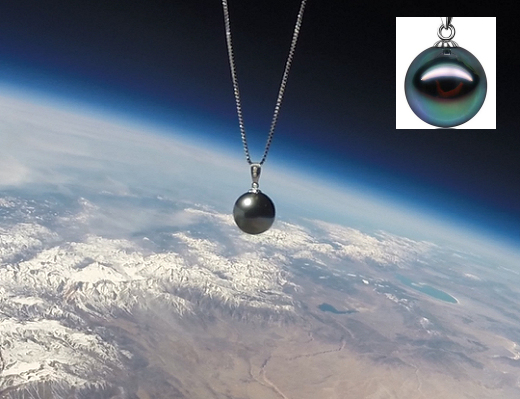
You can have it for $229.95. The students are selling these exotic space pearls to fund their cosmic ray monitoring program. Measuring 10 mm in diameter, the pearl has an 18K white gold clasp and is suspended from a matching 925 Sterling Silver chain. Each pearl comes with a greeting card showing the pendant in flight and telling the story of its journey to the edge of space.
Far Out Gifts: Earth to Sky Store
All sales support hands-on STEM education
Realtime Aurora Photo Gallery
Free: Spaceweather.com Newsletter