MERCURY-VENUS CONJUNCTION: When the sun goes down tonight, step outside and look west. See Venus? She's about to have company. Mercury is approaching for a 1o conjunction on May 21st and 22nd. The planets will be so close together, you can hide them behind a fingertip held at arm's length. Then, on May 23rd and 24th the crescent Moon joins the show. Browse: photo gallery. Sky maps: May 21, 22, 23, 24.


NOCTILUCENT CLOUD SEASON HAS BEGUN: NASA's AIM spacecraft has detected a noctilucent cloud (NLC) inside the Arctic Circle--the first of the 2020 summer season. It is the blue puff in this satellite image of the North Pole:
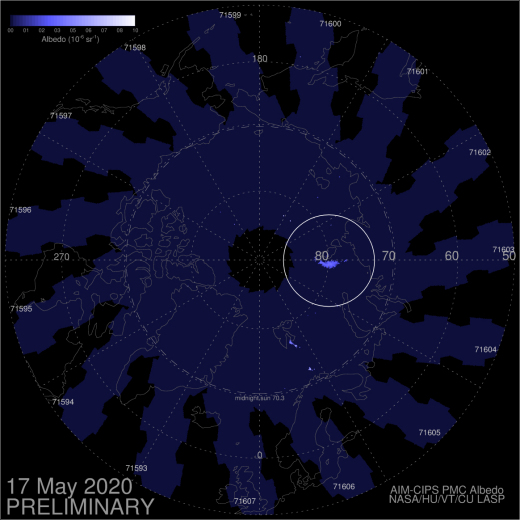
The detection on May 17th marks one of the earliest starts in the 14 year history of the spacecraft. "In previous years, we have seen the first NLCs appear between May 15th and May 27th," says Cora Randall, a member of the AIM science team at the University of Colorado. "Only once, in 2013 (May 15th), has the northern season started earlier than this."
NLCs are Earth's highest clouds. Seeded by meteoroids, they float at the edge of space more than 80 km above the ground. The clouds form when summertime wisps of water vapor rise up to the mesosphere, allowing water to crystallize around specks of meteor smoke. Last summer, they spread as far south as Los Angeles and Las Vegas, setting records for low-latitude sightings.
To find out why NLCs appeared so early this year, Lynn Harvey of the University of Colorado's Laboratory for Atmospheric and Space Physics looked at data from NASA's Microwave Limb Sounder (MLS). The following plots show moisture and temperature in the mesosphere for the past 14 years, with 2020 traced in red:
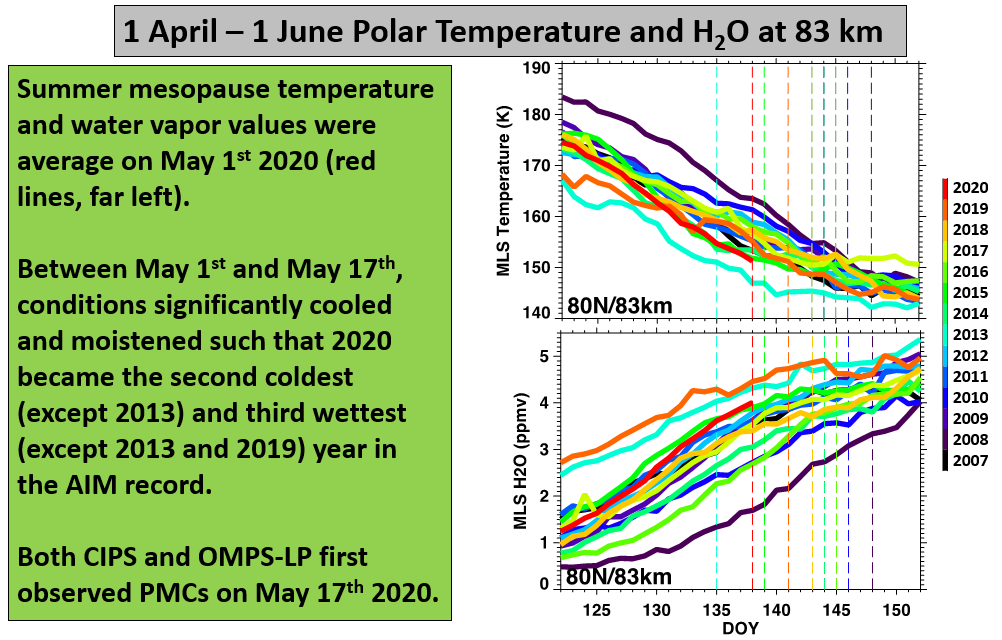
"Between May 1st and May 17th, conditions in the mesosphere significantly cooled and moistened," says Harvey, "such that 2020 became the second coldest and third wettest year in the AIM record."
Noctilucent clouds have been likened to a great "geophysical light bulb" because they turn on abruptly, reaching almost full intensity over a period of no more than 5 to 10 days. This means the little blue puff could soon expand to cover most of the Arctic. Stay tuned!
Realtime Space Weather Photo Gallery
Free: Spaceweather.com Newsletter
THE SPACE HAMMER: Are you looking for a far-out Father's Day gift? Consider the Space Hammer. On May 2nd, the students of Earth to Sky Calculus flew a payload of hammers to the edge of space, 35.0 km (115,000 feet) above Earth's surface onboard a high altitude helium balloon. You can have one for $97.95:

These compact 8 oz. hammers are light enough to fly on a balloon yet dense enough to deliver a powerful blow. The magnetic head holds a nail for one-handed starting, and the stubby 6 in. length is perfect for tight work areas.
Each space hammer comes with a unique gift card showing the tool floating at the top of Earth's atmosphere. The interior of the card tells the story of the flight and confirms that this gift has been to the edge of space and back again.
Far Out Gifts: Earth to Sky Store
All sales support hands-on STEM education
Realtime Aurora Photo Gallery
Free: Spaceweather.com Newsletter