NO SUNSPOTS, ALMOST ALL THE TIME: So far this year, the sun has been blank (without sunspots) 78% of the time. If this rate of spotlessness continues, 2020 will break the Space Age record for low sunspot counts. The previous record was set in 2019 with 77%. Two years in a row with so few sunspots adds up to a very deep Solar Minimum. Worried? Don't. The next solar cycle is coming.
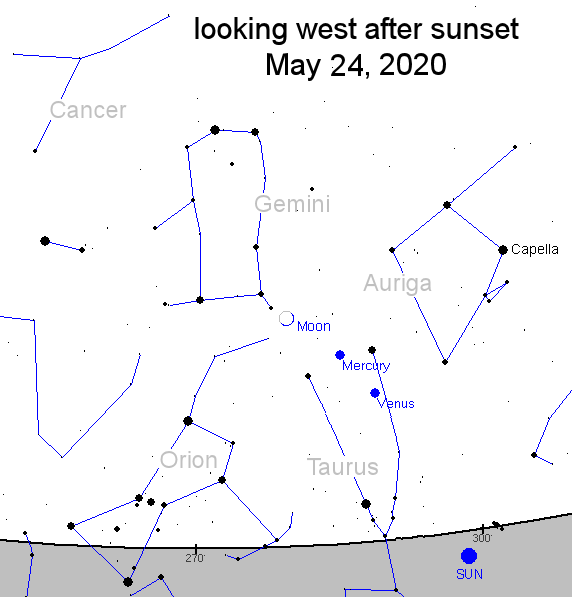
MERCURY-VENUS CONJUNCTION: When the sun goes down tonight, step outside and look west. Venus and Mercury are in conjunction. David Blanchard sends this picture from Flagstaff, AZ:

"Mercury and Venus, separated by just 1°, cast parallel reflections of light on Upper Lake Mary," says Blanchard. "What a view!"
Actually, the view is about to improve. On May 23rd and 24th, an exquisitely thin crescent Moon will join the show, forming a celestial triangle on one night and an almost-straight line the next. It's a nice way to end the day. Sky maps: May 22, 23, 24.


Realtime Conjunction Photo Gallery
Free: Spaceweather.com Newsletter
MORNING COMET SWAN: Comet SWAN (C/2020 F8) is not easy to see. Days away from its close approach to the sun, SWAN makes only the briefest appearance in the pre-dawn sky, just above the northeastern horizon where it is nearly swallowed by the glow of sunrise. The low-hanging comet is easily blocked by trees, buildings ... and clouds:
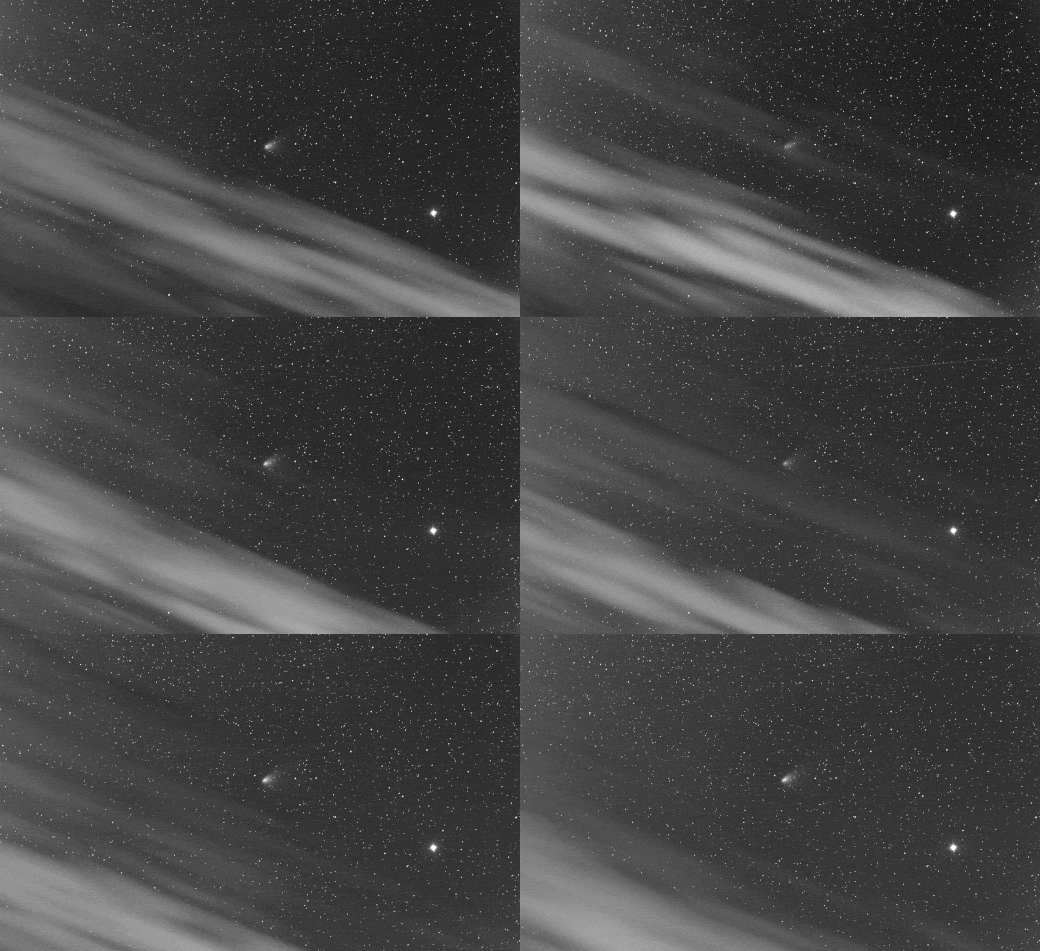
Michael Jaeger of Stixendorf, Austria, captured this short movie of Comet SWAN on May 21st. Jaeger is one of the world's finest photographers of comets, and perhaps only he could turn a cloudy morning into such an artful shot.
In fact, Comet SWAN is turning into a bit of a disappointment. Following a naked-eye outburst in late April, the comet was widely expected to put on a good show this month. Instead, it is fizzling. Current estimates of SWAN's magnitude range from +7 to +6--that is, just below the threshold for naked-eye visibility.

On May 27th, Comet SWAN will swing past the sun near the orbit of Mercury. There, intense solar heat might either re-energize the comet or, more likely, doom it. Astronomers are encouraged to monitor developments. For the rest of the month, the comet may be found in the constellation Perseus; point your optics here.
Realtime Space Weather Photo Gallery
Free: Spaceweather.com Newsletter
THE SPACE HAMMER: Are you looking for a far-out Father's Day gift? Consider the Space Hammer. On May 2nd, the students of Earth to Sky Calculus flew a payload of hammers to the edge of space, 35.0 km (115,000 feet) above Earth's surface onboard a high altitude helium balloon. You can have one for $97.95:
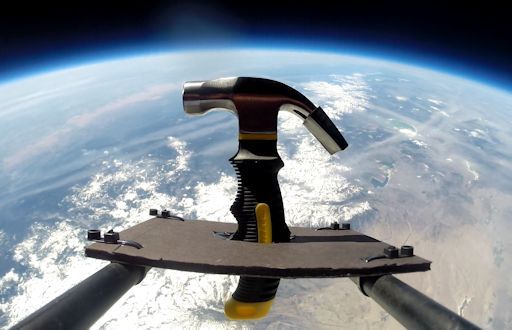
These compact 8 oz. hammers are light enough to fly on a balloon yet dense enough to deliver a powerful blow. The magnetic head holds a nail for one-handed starting, and the stubby 6 in. length is perfect for tight work areas.
Each space hammer comes with a unique gift card showing the tool floating at the top of Earth's atmosphere. The interior of the card tells the story of the flight and confirms that this gift has been to the edge of space and back again.
Far Out Gifts: Earth to Sky Store
All sales support hands-on STEM education
Realtime Aurora Photo Gallery
Free: Spaceweather.com Newsletter