NOCTILUCENT CLOUD SIGHTINGS: Around the north pole, noctilucent cloud (NLC) season is underway. NASA's AIM spacecraft spotted the first NLCs from polar orbit on May 17th. Last night, people on the ground saw them, too. Kairo Kiitsak sends this picture from Simuna, Estonia:

"This is something new for me," says Kiitsak. "I've seen NLCs before, but never so early in the season." The clouds were also sighted in Helsinki, Finland and Jelgava, Latvia.
NLCs are Earth’s highest clouds. Seeded by meteoroids, they float at the edge of space more than 80 km above the ground. The clouds form when summertime wisps of water vapor rise up to the mesosphere, allowing water to crystallize around specks of meteor smoke.
The 2020 NLC season is beginning ahead of schedule. AIM's detection of clouds over the north pole on May 17th marks the 2nd-earliest start to a season since the spacecraft was launched 14 years ago. Ground-based observers often don't see their first clouds until early June.
Northern sky watchers should be alert for more NLCs in the evenings ahead. The clouds can appear after sunset when the sun is more than 6o below the horizon: diagram. They glow electric-blue against the darkening twilight sky and are often filled with finely-structured ripples sculpted by rarefied winds at the edge of space.

Update--Is a rocket to blame? Spaceweather.com reader Ruslan Merzlyakov points out that "last night's bright noctilucent clouds might be due to a technological cause. A Soyuz rocket was launched from Plesetsk Cosmodrome [on May 22nd at 10:31 Moscow Time]." Icy rocket exhaust can catch rays of high-altitude sunlight much like natural noctilucent clouds do, creating similar displays. Stay tuned for updates about this possibility.
Realtime Noctilucent Cloud Photo Gallery
Free: Spaceweather.com Newsletter
SUNSET SKY SHOW: This weekend, you may find the sunset surprisingly beautiful. Witness the reaction of this sky watcher last night in Brodnica, Poland:

Mercury and Venus were in conjunction, beaming brightly through the western twilight. "Although they quickly sank into the evening glow, it was not difficult to catch both planets," says photographer Marek Nikodem. "What a beautiful duo!"
Tonight they will become a beautiful trio. On May 23rd, an exquisitely thin crescent Moon will join the planets, forming a triangle in the twilight. On May 24th, the threesome will shapeshift into an almost straight line. Step outside at sunset, look west, and enjoy the show. Sky maps: May 23, 24.


Realtime Space Weather Photo Gallery
Free: Spaceweather.com Newsletter
THE INFINITY BLACK PEARL: It came from Tahiti--and now it's been to the edge of space. On April 15, 2020, this genuine Black Tahitian South Sea Cultured Pearl flew to the stratosphere onboard an Earth to Sky Calculus cosmic ray balloon, soaring 107,611 feet above the Sierra Nevada mountains of central California:
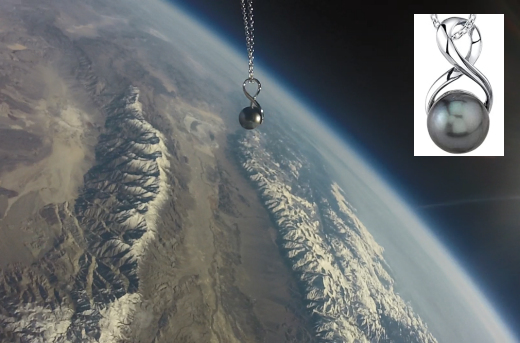
You can have it for $249.95. The students of Earth to Sky Calculus are selling these exotic space pearls to fund their cosmic ray monitoring program.
Measuring 9 mm in diameter, the pearl is mounted on a 925 sterling silver infinity twist and suspended on a matching 17 inch long sterling silver chain. Each pearl comes with a greeting card showing the pendant in flight and telling the story of its journey to the edge of space.
Far Out Gifts: Earth to Sky Store
All sales support hands-on STEM education
Realtime Aurora Photo Gallery
Free: Spaceweather.com Newsletter