SOLAR MINIMUM CONDITIONS ARE IN EFFECT: The sun has been blank (without sunspots) for 23 days in a row--a sign that Solar Minimum is underway. In fact, it's shaping up to be the deepest Solar Minima of the Space Age. So far this year the sun has been blank 78% of the time, a rate of spotlessness we haven't seen since 1913 (85%). During Solar Minimum there are few sunspots and solar flares, but extra cosmic rays. Aurora alerts: SMS Text.
NAKED-EYE JELLYFISH SPRITES: Have you ever seen a sprite? Some say it's impossible. The strange and fleeting forms of red lightning materialize above thunderheads, usually disappearing again in less time than it takes to blink. Yet storm chaser Michael Gavan had no trouble seeing these on May 23rd:

"Extremely bright 'jellyfish' sprites were easily visible naked-eye through evening twilight!" says Gavin. "This is a framegrab of the brightest one I managed to capture with my astrophotography-modified Canon T3i."
Gavin saw the display from northwestern Kansas. "Clear skies afforded fantastic views of an MCS (Mesoscale convective system) moving through the Nebraska panhandle almost 100 miles away," he says. "I wasn't the only one who saw them. Reports were coming in that people were seeing sprites from Interstate 70 as well."
The storm lasted so long, Gavin had time to attach an 85mm lens to his camera for some close-up shots. "Because I had an image of the same area without a sprite from a few seconds earlier, I was able to subtract the sky (stars, airglow, etc) to make a 'difference image' of the sprite structure without any distractions." This is the result:

"There are some very interesting fine-scale features in jellyfish sprites!" he says.
Solar Minimum could be boosting sprites. During the low phase of the solar cycle--happening now--cosmic rays from deep space flood into the inner solar system relatively unimpeded by the sun's weakening magnetic field. Some models hold that cosmic rays help sprites get started by creating conductive paths in the atmosphere. If so, now is a good time to look for jellyfish in the sky: Viewer's guide.
Realtime Space Weather Photo Gallery
Free: Spaceweather.com Newsletter
BRIGHT LIGHT FROM A JAPANESE SPACEHIP: Spoiler alert: This spaceship did not explode. But it looked like it did. On May 24th, Ralf Vandebergh was watching Japan's HTV9 robotic cargoship fly over the Netherlands, and this is what he saw:

"I used my 10-inch telescope to record this bright flare coming off the HTV9 on its way to the International Space Station," says Vandebergh. "Sunlight briefly glinted from the HTV9's elongated body, creating an outburst of light."
The HTV9 is still intact, and that's good news for the crew of the space station. They are looking forward to the delivery of fresh food contained inside the spacecraft's pressurized interior. HTV9 is also delivering a major experiment in microgravity combustion as well as some fresh lithium-ion batteries for the ISS. The spacecraft was launched from Japan on May 21st and is scheduled to reach the space station later today.
Realtime Space Weather Photo Gallery
Free: Spaceweather.com Newsletter
THE INFINITY BLACK PEARL: It came from Tahiti--and now it's been to the edge of space. On April 15, 2020, this genuine Black Tahitian South Sea Cultured Pearl flew to the stratosphere onboard an Earth to Sky Calculus cosmic ray balloon, soaring 107,611 feet above the Sierra Nevada mountains of central California:
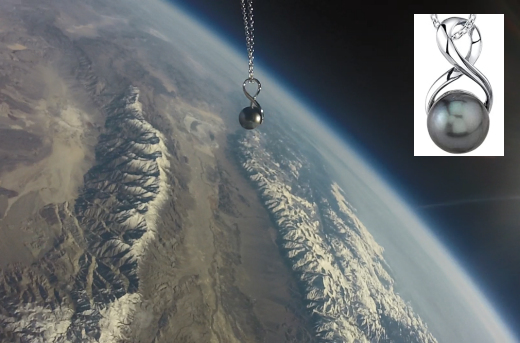
You can have it for $249.95. The students of Earth to Sky Calculus are selling these exotic space pearls to fund their cosmic ray monitoring program.
Measuring 9 mm in diameter, the pearl is mounted on a 925 sterling silver infinity twist and suspended on a matching 17 inch long sterling silver chain. Each pearl comes with a greeting card showing the pendant in flight and telling the story of its journey to the edge of space.
Far Out Gifts: Earth to Sky Store
All sales support hands-on STEM education
Realtime Aurora Photo Gallery
Free: Spaceweather.com Newsletter