INTRODUCING THE GREEN GHOST: Citizen scientists have discovered a new form of upper atmospheric lightning: The Green Ghost. Catalogued for the first time only a year ago, Green Ghosts appear above strong sprites, leaving a weird verdant afterglow at the edge of space. A fine specimen was just captured over New Mexico. FULL STORY.
INFERIOR CONJUNCTION OF VENUS: Tomorrow, June 3rd, Venus will pass almost directly between the Earth and the sun. This is having a strange effect on the planet's shape. "It is like a ring of fire," says Didier Favre, who sends this picture from Brétigny-sur-Orge, France:

When Favre took the picture on June 1st, the sun was only 2 degrees from Venus–hence the blue sky. "It was not an easy picture to take," says Favre, "but what a beautiful view!"
Why does Venus look like a ring? Simple: The planet's nightside is facing Earth. Sunlight filtering through the edge of Venus’s carbon dioxide atmosphere forms a luminous ring around the dark disk.
Astronomers call this an "inferior conjunction of Venus," and it's one of the best in decades. At closest approach on June 3rd, Venus will be 29 arcminutes (about half a degree) from the center of the solar disk. Only twice since 1961 has Venus come closer–during the famous Venus Transits of 2004 and 2012 [ref].
Observing Venus at this time is dangerous. With the sun just a fraction of a degree away, it is easy for stray sunlight to sneak into optical systems, damaging sensitive electronics and hurting human eyes. Only skilled observers taking careful precautions should attempt it.

Note: The horizontal line running through Venus is caused by the planet's bright light overloading the pixels of SOHO's digital camera.
In space, the Solar and Heliospheric Observatory (SOHO) will monitor the conjunction using a coronagraph. In such a device, opaque disks block the glare of the sun, revealing nearby stars and planets. It’s a type of artificial solar eclipse.
Even SOHO will have some trouble, though. On June 3rd, Venus will be so close to the sun that it briefly dips behind the coronagraph’s opaque disks, hiding the moment of closest approach. Ground-based observers will have to try to fill in the gap. Stay tuned for the latest images!
Realtime Venus Photo Gallery
Free: Spaceweather.com Newsletter
ARCTIC WOLF PENDANT: This wolf glows in the dark--and it's been to space. The students of Earth to Sky Calculus launched this special pendant to the stratosphere on April 15, 2020, on board a high-altitude cosmic ray balloon. The payload of radiation sensors (and lupine jewelry) traveled 107,611 feet above Earth's surface:
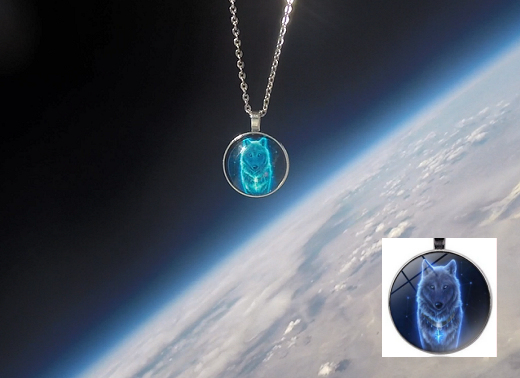
You can have it for $99.95. The students are selling these pendants to support their cosmic ray ballooning program. Each one comes with a greeting card showing the wolf in flight and describing its journey to the stratosphere and back again.
Far Out Gifts: Earth to Sky Store
All sales support hands-on STEM education
Realtime Space Weather Photo Gallery
Free: Spaceweather.com Newsletter
Realtime Aurora Photo Gallery
Free: Spaceweather.com Newsletter