INFERIOR CONJUNCTION OF VENUS: Today, Venus is making a close approach to the sun--an event astronomers call "inferior conjunction." With only 29 arcminutes of separation, it's one of the closest approaches in decades. Astronomers daring enough to observe the event are capturing rare images of Venus backlit by the sun. It looks like a tiny ring of fire! Full story | Photo gallery.
Boyang Liu sends this picture from Perth, Australia:

"This is Venus only 40.5 arcmin from the sun on June 3rd," says Liu. "I used a high building to block the sun, then used the small chance window of ~3 minutes to capture Venus. It took me 3-4 tries, after each one I moved the telescope to sunlight and waited for the next shadow. There were many dust particles in the sunlight, making automatic alignment unusable, so I had to manually align the frames. It was time-consuming, but worth the effort."
Warning: Observing Venus today is dangerous. With the sun just a fraction of a degree away, it is easy for stray sunlight to sneak into optical systems, damaging sensitive electronics and hurting human eyes. Only skilled observers taking careful precautions should attempt it.
Realtime Venus Photo Gallery
Free: Spaceweather.com Newsletter
ANOTHER SOLAR CYCLE 25 SUNSPOT: A new sunspot is emerging over the sun's southeastern limb. Provisionally numbered AR2765, it is inset in this magnetic map of the sun’s surface from NASA’s Solar Dynamics Observatory:

AR2765 is a member of new Solar Cycle 25. We know this because of its magnetic polarity. According to Hale's Law, sunspots switch polarities from one solar cycle to the next. Southern sunspots from old Solar Cycle 24 have a -/+ polarity. This sunspot is the opposite: +/-, marking it as a member of Solar Cycle 25.
On June 1st, before this sunspot rotated into view, it produced a long-duration B-class solar flare. This suggests AR2765 is capable of explosive activity. Geoeffective flares could occur as the sunspot turns toward Earth this week. Stay tuned! Solar flare alerts: SMS Text.
Realtime Space Weather Photo Gallery
Free: Spaceweather.com Newsletter
ARCTIC WOLF PENDANT: This wolf glows in the dark--and it's been to space. The students of Earth to Sky Calculus launched this special pendant to the stratosphere on April 15, 2020, on board a high-altitude cosmic ray balloon. The payload of radiation sensors (and lupine jewelry) traveled 107,611 feet above Earth's surface:
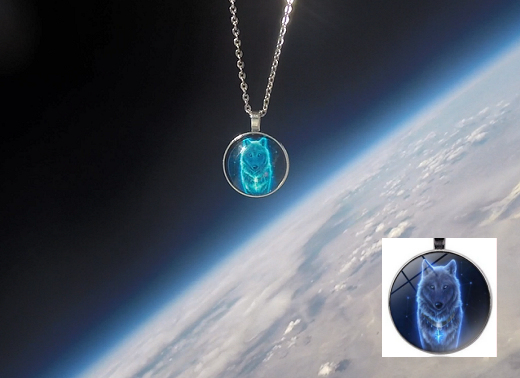
You can have it for $99.95. The students are selling these pendants to support their cosmic ray ballooning program. Each one comes with a greeting card showing the wolf in flight and describing its journey to the stratosphere and back again.
Far Out Gifts: Earth to Sky Store
All sales support hands-on STEM education
Realtime Aurora Photo Gallery
Free: Spaceweather.com Newsletter