PENUMBRAL LUNAR ECLIPSE: This Friday, the full Moon will pass through the outskirts of Earth's shadow, producing a penumbral lunar eclipse. Play this movie to see what it will look like. The eclipse will be visible from Africa, Australia, Antarctica, parts of South America and Asia--basically everywhere except North America. Maximum eclipse occurs on June 5th at 1925 UTC. Browse: Eclipse Photo Gallery.
INFERIOR CONJUNCTION OF VENUS: Yesterday, Venus passed less than 1/2 a degree from the sun--an event astronomers call "inferior conjunction." How dangerous is that to observe? In Forges les bains, France, amateur astronomer Nicolas Lefaudeux stripped his telescope of anything that could catch fire:

"Observing Venus close to the sun is extremely dangerous," says Lefaudeux. "Instead of trying to shade the sun, I removed anything that could burn! The telescope tube is replaced by a metal bar, and the sun is focused on a glass prism that reflects dangerous sunlight away from the camera. This allowed me to observe Venus very close to the sun, only 36 arcminutes from the solar limb!"
"High clouds prevented me from observing Venus even closer to the sun later in the day," says Lefaudeux. "Yet, I am very happy that the time dedicated to this paid off, and I was able to capture the full Venus ring safely!"

Venus looks like a ring because, at inferior conjunction, the planet's night side faces Earth. Sunlight filtering around the edge of Venus's atmosphere outlines the dark disk with an annulus of light. Photographs of the Venusian "ring of fire" are very rare--yet several may be found in today's photo gallery.
Realtime Venus Photo Gallery
Free: Spaceweather.com Newsletter
SUNSPOT SUNSET: There's a sunspot in this photo. Can't find it? Look here. Juan Manuel Perez Rayego took the picture yesterday when the sun set over Merida, Spain.


"Sunspot AR2765 was visible near the edge of the sun--just barely, but it was there," he says.
During Solar Minimum (underway now) the sun is usually blank and featureless. However, new Solar Cycle 25 is showing signs of life, and AR2765 is the largest sunspot so far of the young solar cycle--large enough to appear in sunset photos. Soon, perhaps, it will start to flare as well. Stay tuned!
Caution: Even when the sun is dimmed by low-hanging clouds or haze, it can still damage your eyes. Sunlight magnified by unfiltered optics is dangerously bright. If you chose to photograph the low sun, as Rayego did, use the camera's LCD screen for safe viewfinding. Never look into the eyepiece of an unfiltered camera or telescope when the sun is in the field of view.
Realtime Space Weather Photo Gallery
Free: Spaceweather.com Newsletter
ARCTIC WOLF PENDANT: This wolf glows in the dark--and it's been to space. The students of Earth to Sky Calculus launched this special pendant to the stratosphere on April 15, 2020, on board a high-altitude cosmic ray balloon. The payload of radiation sensors (and lupine jewelry) traveled 107,611 feet above Earth's surface:
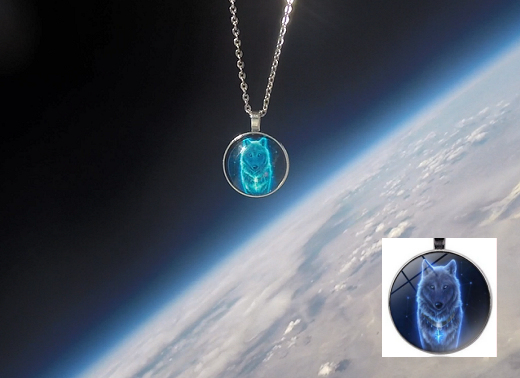
You can have it for $99.95. The students are selling these pendants to support their cosmic ray ballooning program. Each one comes with a greeting card showing the wolf in flight and describing its journey to the stratosphere and back again.
Far Out Gifts: Earth to Sky Store
All sales support hands-on STEM education
Realtime Aurora Photo Gallery
Free: Spaceweather.com Newsletter