DAYTIME METEOR SHOWER: This weekend, step outside under the bright blue sky and feel the warmth of the sun overhead. Would you believe, there's a meteor shower underway? Earth is passing through a stream of debris from an unknown comet, source of the annual Arietid meteor shower. It is active during broad daylight. As many as 60 meteors per hour are streaking from a radiant right beside the glaring sun. The peak of this invisible (yet real) meteor shower is June 7th.
SIGNS OF LIFE FROM SOLAR CYCLE 25: This weekend, the biggest sunspot of new Solar Cycle 25 (so far) is turning toward Earth. AR2765 is inset in this magnetic map of the sun’s surface from NASA’s Solar Dynamics Observatory:

We know AR2567 is a member of Solar Cycle 25 because of its magnetic polarity. According to Hale's Law, sunspots switch polarities from one solar cycle to the next. Southern sunspots from old Solar Cycle 24 have a -/+ polarity. This sunspot is the opposite: +/-, marking it as a member of Solar Cycle 25.
The primary dark core of AR2765 is about as wide as Earth, with two satellite sunspots closer in size to the Moon. A frothy wake of magnetic turbulence stretches 70,000 miles behind the trio. These dimensions make the sunspot group an easy target for backyard solar telescopes.
The sun is still in the pits of a century-class Solar Minimum. The appearance of AR2765 suggests that it won't last forever. Solar Cycle 25 has been showing signs of life all year long, with 82% of all sunspots in 2020 having the magnetic polarity of the new cycle. What's next? Solar flares? Stay tuned.
Realtime Space Weather Photo Gallery
Free: Spaceweather.com Newsletter
MYSTERIOUS TWINNED RAINBOW: Scientists have been studying rainbows for hundreds of years, since the 17th century when Isaac Newton first explained the colorful arcs. Yet after all these years, there is one rainbow scientists do not fully understand--the "twinned bow." Jan Curtis photographed this specimen on June 2nd from Cheyenne, Wyoming:

"This is only the 3rd time I've ever seen a rare 'twinned rainbow'," says Curtis. "It followed a heavy storm with hail."
"Several twinned bows have been imaged, mostly during heavy showers, but currently there is no agreed explanation for them," writes atmospheric optics expert Les Cowley. "They might form from a mixture of water drops and ice spheres."
Indeed, Curtis notes, "hail can be seen falling right under the primary rainbow."
"A stronger possibility is that non-spherical raindrops produce one or both bows," Cowley adds. "Surface tension forces keep small raindrops fiercely spherical but as they fall large drops are flattened by air resistance or might even oscillate between flattened and elongated spheroids."
Realtime Rainbow Photo Gallery
Free: Spaceweather.com Newsletter
ARCTIC WOLF PENDANT: This wolf glows in the dark--and it's been to space. The students of Earth to Sky Calculus launched this special pendant to the stratosphere on April 15, 2020, on board a high-altitude cosmic ray balloon. The payload of radiation sensors (and lupine jewelry) traveled 107,611 feet above Earth's surface:
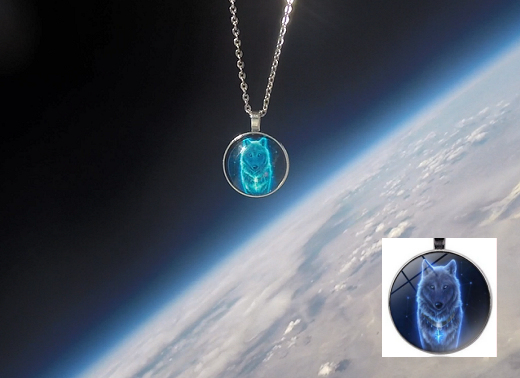
You can have it for $99.95. The students are selling these pendants to support their cosmic ray ballooning program. Each one comes with a greeting card showing the wolf in flight and describing its journey to the stratosphere and back again.
Far Out Gifts: Earth to Sky Store
All sales support hands-on STEM education
Realtime Aurora Photo Gallery
Free: Spaceweather.com Newsletter